
 3
Contents
- What is the applicable tax rate for crypto-asset transactions in Cyprus?
- Which taxpayers are subject to the crypto-asset income tax?
- Are crypto-asset transactions subject to Capital Gains Tax?
- Is crypto-asset income aggregated with an individual’s other income?
- Which transactions qualify for crypto-asset taxation?
- Can crypto-asset operational losses be carried forward or offset against other income?
- Does Cyprus offer a preferential crypto-asset tax regime compared to other jurisdictions?

What is the applicable tax rate for crypto-asset transactions in Cyprus?
On 31 December 2025, the Income Tax Law was amended with the insertion of Article 20E, which establishes the statutory framework for crypto-asset taxation effective 1 January 2026.
Under this provision, profits derived from the disposal of crypto-assets are subject to a flat tax rate of 8%, regardless of the legal status of the recipient. Consequently, crypto transaction profits earned by both individual and corporate taxpayers are subject to the exact same tax rate.
The tax scale is flat, meaning the rate remains unchanged irrespective of total income volume. Furthermore, the holding period of the asset prior to sale does not impact the tax liability, and there is no minimum tax-free threshold, unlike the progressive personal income tax brackets applied in Cyprus.
Which taxpayers are subject to the crypto-asset income tax?
The 8% tax rate on the disposal of crypto-assets applies to any person or corporate entity falling under the following categories:
- Individual tax residents of Cyprus on their worldwide income
- Corporate tax residents of Cyprus on their worldwide income
- Non-resident individuals or corporate entities on income derived from Cyprus sources or through a permanent establishment (PE) in Cyprus
Are crypto-asset transactions subject to Capital Gains Tax?
No. Profits derived from the disposal of crypto-assets are completely exempt from Capital Gains Tax (CGT), as Article 20E of the Income Tax Law operates as an independent statutory framework.
Is crypto-asset income aggregated with an individual’s other income?
No. Crypto-asset revenues are not aggregated with an individual's general taxable income base. These gains do not shift the taxpayer into higher progressive personal income tax brackets.
Which transactions qualify for crypto-asset taxation?
Under Cyprus law, a crypto-asset is defined as a digital representation of value or rights that can be transferred and stored electronically using distributed ledger technology (DLT) or similar frameworks. This statutory definition aligns with the European Union's Markets in Crypto-Assets Regulation (MiCA (EU) 2023/1114).
The statutory definition of a disposal includes the following operations:
- Sales of crypto-assets for fiat currency
- Gratuities and non-repayable transfers
- Crypto-to-crypto exchanges, including stablecoin conversions
- Settlements for goods and services executed using cryptocurrencies
Remittances between an individual’s or entity's own digital wallets do not constitute a disposal. However, exchanging one token for another is classified as a taxable event. Unrealized crypto gains, such as positive fair value adjustments on trading inventories under IFRS, are not subject to tax, and unrealized losses are non-deductible.
Consequently, most other crypto-related operations remain outside this specialized tax regime. For instance, corporate crypto-mining profits are taxed at standard corporate rates: 12.5% for tax periods ending on or before 31 December 2025, and 15% starting 1 January 2026.
Can crypto-asset operational losses be carried forward or offset against other income?
No. Crypto-asset trading losses can only be offset against profits generated within the exact same tax period, and strictly against gains derived from the disposal of crypto-assets.
Does Cyprus offer a preferential crypto-asset tax regime compared to other jurisdictions?
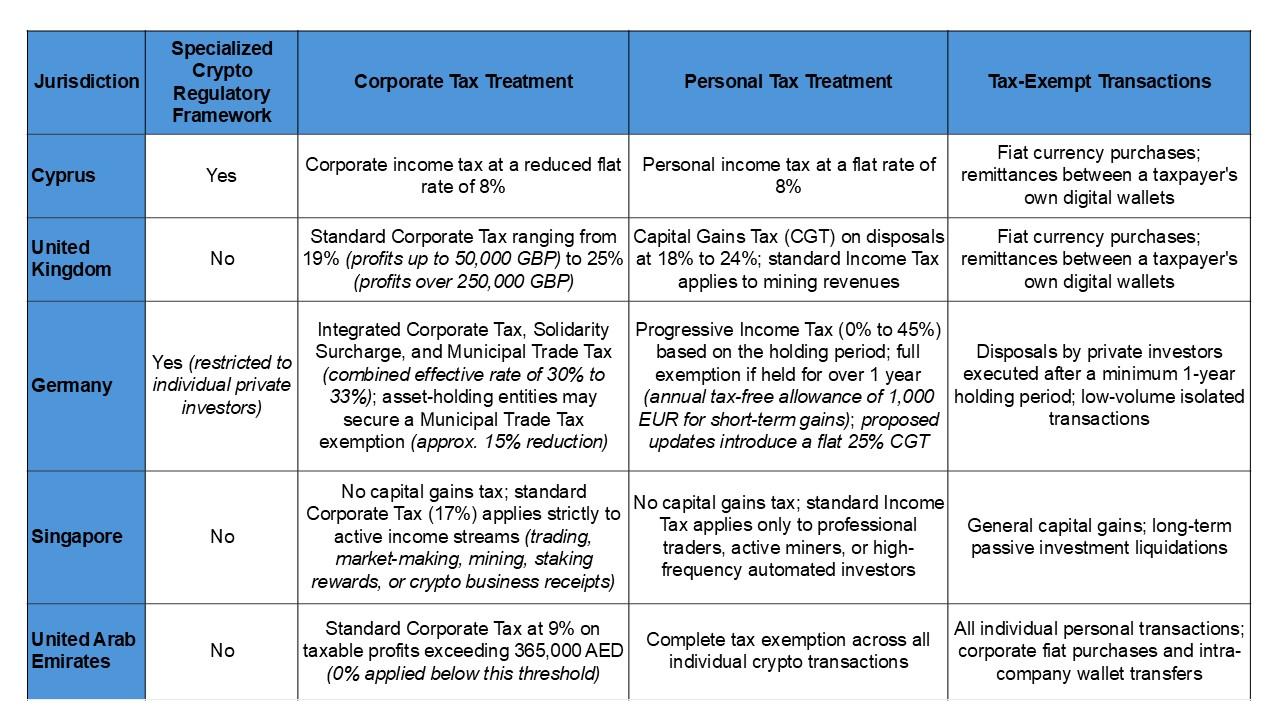
When benchmarking the newly implemented Cyprus framework against global tax practices, the jurisdiction presents a highly competitive environment.
First, most countries that offer tax exemptions for private cryptocurrency investors (such as Germany) apply standard corporate income tax rates to corporate entities. Cyprus applies its reduced rate to both groups.
Second, the 8% flat rate is one of the lowest corporate rates in Europe, and not only in Europe. Particularly, when compared to standard corporate tax benchmarks applied to yet non-regulated sectors like crypto-mining.
Third, similar to Singapore, Cyprus does not levy capital gains tax on these assets. While certain jurisdictions like the UAE offer a lower individual tax burden, Cyprus remains a premier European baseline.
Below is a comparative analysis of global cryptocurrency taxation frameworks across targeted jurisdictions.
References

Add a comment