Law & Consulting © 1999—2026

GSL / International Taxation / Cyprus

Taxation and Tax Planning in Cyprus

Taxation in Cyprus is characterized by a moderate fiscal burden and transparent regulation under the EU standards. The primary taxes include corporate income tax, personal income tax, and VAT, with the corporate tax rate remaining among the lowest in the European Union, while dividends and capital gains may be fully exempt from taxation subject to specific conditions. An extensive network of DTTs with over 70 countries makes the jurisdiction an effective hub for international business. GSL experts provide comprehensive tax planning and advisory services to help you structure corporate ownership in Cyprus, leverage preferential regimes (including the IP Box), and ensure full economic substance compliance.

Core Taxes

Corporate Income Tax
15%
Personal Income Tax
0 – 35%
Capital Gains Tax
20%
VAT
19%
Withholding Tax (Dividends/Interest)
No
Withholding Tax (Royalties)
10%

Key Features of the Tax System

Taxation Principle

Worldwide income

Tax Residency Criteria (Individuals)

183-day rule / 60-day rule

Tax Residency Criteria (Companies)

Place of effective management and control

CFC Rules

Individuals – no / Companies – yes

Foreign Exchange Control

No

National Currency

Euro (EUR)

Tax Authority

Tax Department

Tax Department

Established on 1 July 2014 by merger of the Department of Inland Revenue and the Value Added Tax Service, this authority is responsible for administering direct and indirect taxes (including VAT), collecting tax revenue for the state budget, implementing double taxation treaties (DTTs), and exchanging tax-related information with other countries in accordance with EU directives and international conventions.

In 2023, the tax authority introduced the Tax For All (TFA), system – a centralised digital platform designed to consolidate and streamline the administration of all types of taxes for both individuals and businesses. It was intended to gradually replace the legacy TAXISnet system. Although some functions have been successfully migrated to the new portal, technical issues have so far prevented a complete transition; consequently, both systems remain in use.

Corporate Tax Residency Criteria

A business entity is considered a tax resident of Cyprus if its management and control are exercised from within the Republic of Cyprus. A company registered in (or redomiciled to) Cyprus is also deemed a tax resident, provided that it is not a tax resident of any other country.

Taxation

Corporate Income Tax

In Cyprus, corporate income tax is levied on the income of tax resident legal entities, whether such income is generated in Cyprus or abroad. Non-resident companies are subject to corporate income tax only if the profit is derived through a permanent establishment located in Cyprus.

Taxable income includes:

  • profits from business activities;
  • income from provision of services;
  • income from the use of intellectual property;
  • income from the leasing of property;
  • interest income earned in the ordinary course of a company’s business activities.

Dividends received by a Cyprus company are generally exempt from corporate income tax, provided that certain conditions are met. Proceeds from the disposal of securities (such as shares, bonds, or other financial instruments) are also exempt from taxation.

However, income derived from the disposal of Cyprus real estate, as well as the disposal of certain types of shares in companies that own Cyprus real estate, may be subject to capital gains tax (see the section ‘Capital Gains Tax’).

Deductible Expenses

The tax base for corporate income tax is a company’s taxable profit, as determined based on accounting records. When calculating the tax base, a company is entitled to reduce its taxable profit by expenses directly related to the generation of taxable income.

Such expenses may include:

  • employee labour costs (wages and salaries);
  • rental payments for premises and utility charges;
  • costs for the repair and maintenance of fixed assets;
  • depreciation charges;
  • research and development (R&D) expenditures;
  • other documented expenses.

Rate

Cyprus applies a flat corporate income tax rate of 15%.

Tax Return Filing and Tax Payment

For a long time, the deadline for filing a corporate income tax return was 31 March of the second year following the reporting year (i.e., 15 months after the end of the accounting period). As a result of the recent tax reform, tax periods beginning in 2026 have their filing time reduced to 13 months, with the new deadline set as 31 January of the second year following the tax year. Thus, the tax return for the tax year 2026 must be filed by 31 January 2028.

Tax returns must be filed electronically via the Tax For All system.

A company’s tax liability is divided into two parts: a provisional tax payment and the remaining balance of the corporate income tax. The provisional tax is paid in two instalments – by 31 July and 31 December of the current tax period, while the remaining balance is paid after the end of the tax year.

IP Box

Speaking of corporate income tax, it is worth noting the special tax regime in place in Cyprus for qualifying intellectual property (IP) income known as the IP Box regime.

Advantages

The benefit of IP Box is that, for tax purposes, 80% of the profit generated by a company from qualifying IP assets is treated as a deductible expense. Consequently, the taxable base consists of the remaining 20% ​​of the profit.

The regime applies to patents, software, and other protected IP assets (excluding marketing-related assets such as trademarks, trade names, etc.). The applicable tax rate depends on the proportion of ‘qualifying expenditures’ (in-house R&D plus R&D outsourced to third-party contractors) relative to the total development costs. The maximum benefit under the IP Box regime is achieved when a Cyprus company develops the IP on its own.

To qualify for this preferential regime, a company must establish a genuine economic substance in Cyprus (including a physical office, qualified personnel based in Cyprus, and a local director) and must also maintain a substantial research and development presence in Cyprus; in other words, the IP asset must be the result of R&D activities.

Given that the standard corporate income tax rate in Cyprus is 15%, the effective tax rate on income derived from qualifying IP assets can be as low as 3%, provided that all necessary conditions are met.

Key advantages of IP Box in Cyprus Peculiarities of calculating the tax Main requirements for IP Box companies
Significant tax reduction:: the effective tax rate on profits derived from IP is 3%.

This relief applies to patents, software, and other protected IP assets (excluding marketing-related assets such as trademarks, trade names, etc.).

The extent of the relief depends on the proportion of ‘qualifying expenditures’ (in-house R&D plus R&D outsourced to third-party contractors) relative to the total development costs. Substance: it is mandatory to have a physical office and qualified personnel in Cyprus, as well as a local director who manages the company from Cyprus and adopts resolutions while on the island.

Link to R&D: the asset must be created through actual research and development. Simply acquiring the rights does not make one eligible for the tax relief.

Outsourcing option: it is permissible to engage independent third-party contractors to carry out R&D without completely forfeiting the tax relief (though the effective rate will be higher than 3%). Tiered tax rates based on the IP origin:

1) In-house development (exclusively in Cyprus): The effective tax rate is 3%.

2) Acquisition of IP followed by further development by an independent contractor: The effective tax rate will be higher than 3%.

3) Acquisition of IP or outsourcing to a related party: Tax is applied at a rate of 15%.

Separate accounting and documentation: It is mandatory to maintain separate records of qualifying income and expenditures, as well as to retain technical documentation substantiating the development process.

Withholding Tax

Generally, income in the form of dividends and interest paid by Cyprus companies to non-Cyprus legal entities is not subject to withholding tax (WHT). Royalties may be subject to tax at a rate of 10% (5% in the case of motion pictures) if the intellectual property rights owned by a non-resident are used in Cyprus.

However, as part of the tax reform which entered into force on 1 January 2026, Cyprus has introduced several key changes to the general rule.

Dividends paid to EU non-cooperative (‘blacklisted’) jurisdictions are now subject to a 17% withholding tax, while payments made to related legal entities in low-tax jurisdictions (i.e., countries where the corporate income tax rate is less than 50% of the Cyprus rate) are subject to a 5% withholding tax.

Interest payments to non-cooperative jurisdictions are also taxed at 17%; meanwhile, payments to associated companies in low-tax territories do not trigger a withholding tax specifically, but they may be potentially non-deductible for corporate income tax purposes.

Royalties paid to non-cooperative jurisdictions are subject to a 10% tax, while those paid to low-tax jurisdictions are no longer tax-deductible.

Jurisdiction of the non-resident company receiving income
Ordinary Low-Tax EU Non-Cooperative
Dividends 0% 5% 17%
Interest 0% 0%, but no deduction 17%
Royalties (rights not used in Cyprus) 0% 0%, but no deduction 10%

VAT

In Cyprus, value added tax (VAT) is levied on:

  • supply of goods and provision of services in Cyprus;
  • acquisition in Cyprus of goods from other EU member states;
  • importation of goods from non-EU countries.

The obligation to withhold VAT applies to persons registered as VAT taxpayers. Registration is required if the total value of VAT-taxable supplies over the preceding 12 months has exceeded EUR 15,600, or if the total value of transactions carried out within the EU over the course of a year has exceeded EUR 100,000.

Rate

19% standard rate, applicable to most supplies of goods and services, acquisitions of goods and services from other EU countries, and imports of goods from outside the EU
9% hotel and restaurant services, certain passenger transport services, and some other transactions
5% specific categories of food products, animal feed, and medicinal products

for the acquisition of a primary residence in Cyprus – the first 130 m² of the total area of ​​the residential property, provided that:

  • the value of the property does not exceed EUR 350,000,
  • the total transaction value does not exceed EUR 475,000, and
  • the total built-up area does not exceed 190 m²
3% sales of printed materials (excluding those for advertising purposes) and supply of goods for people with disabilities
0% exports of goods outside the EU, certain international transport services, and various other transactions

Since these transactions are considered taxable, taxpayers retain the right to claim a deduction for input VAT.

Tax Return Filing and Tax Payment

The tax period for VAT is a quarter. After the end of each quarter, a VAT payer is required to submit a tax return and pay the tax no later than the 10th day of the second month of the quarter following the relevant tax period. VAT returns must be submitted exclusively in electronic form via Tax For All.

Capital Gains Tax

In Cyprus, capital gains tax (CGT) applies to resident companies, as well as to non-resident legal entities, with respect to gains derived from Cyprus sources.

CGT is levied on gains realised by companies from the sale or other form of disposal (for consideration) of:

  • immovable property located in Cyprus;
  • shares in companies that own immovable property located in Cyprus, provided that such shares are not traded on a recognised stock exchange;
  • shares in companies that, directly or indirectly, hold an interest in the capital of entities owning Cyprus immovable property, provided that at least 20% of the market value of such shares is derived from immovable property located in Cyprus.

The tax base for CGT is the capital gain, defined as the difference between the disposal value of an asset and its acquisition cost, taking into account expenses directly related to the acquisition, improvement, and disposal of the asset.

Rate

The capital gains tax rate in Cyprus is 20%.

Tax Return Filing and Tax Payment

CGT taxpayers are required to calculate the tax amount and submit the relevant tax return within one month from the date of the transaction involving the disposal of the asset. The return must be filed electronically via Tax For All platform. The tax must be paid prior to the registration of the transfer of ownership of the real estate or shares from the seller to the buyer.

Social and Health Insurance

Cyprus legislation provides for mandatory contributions to social and health insurance funds, which must be made by employees, employers, and the state itself.

Social Insurance Contributions

Companies that have employees are required to contribute 8,8% of insurable earnings to the Social Insurance Fund. It should be noted that the portion of social insurance contributions payable by an employee is withheld by the employer from the employee’s earnings and remitted to the Social Insurance Fund. The portion payable by the employer is covered by the company using its own funds.

Social insurance contributions are not levied on earnings that do not exceed a specified minimum threshold. The exact remuneration amounts falling into this category are determined by the Minister of Labour orders.

The maximum insurable income is set by annual orders of the Minister of Labour; for 2026, this amount is EUR 5,742 per month (EUR 1,325 per week). Any income exceeding this threshold is not subject to such contributions.

Other insurance contributions

In addition to contributions to the Social Insurance Fund in Cyprus, employers are required to make payments, from their own money, to the following funds and organisations:

Redundancy Fund 1,2% of an employee’s earnings
Human Recourse Development Authority 0,5% of a company’s total expenditure on employee wages
Social Cohesion Fund 2% of the total wages paid by a company to its employees

Health Insurance Contributions

Employers contribute 2.9% of each employee’s remuneration to the state Health Insurance Fund. These contributions are capped at EUR 180,000 of an individual employee’s total earnings.

Special Defence Contribution

Special Defence Contribution (SDC) can be levied on resident companies in respect of certain types of passive income.

Dividends

As a general rule, dividends received by a resident company from another Cyprus company are exempt from SDC.

However, Cyprus tax law includes a specific anti-avoidance provision, under which this exemption may be lost if dividends received by one resident company from another resident company are not distributed within four years of their receipt.

In such a case, dividends received in 2026 out of 2024–2025 profits, as well as dividends received in 2027 out of 2025 profits, are subject to SDC at a rate of 17%. Dividends received after these periods are subject to tax at a rate of 5%.

Dividends received by a resident company from a foreign company are exempt from taxation. However, this exemption does not apply (and such foreign dividends may instead be subject to SDC) if both of the following conditions are met:

  • More than 50% of the foreign company’s income consists of passive income;
  • The foreign company is subject to tax at a rate significantly lower than that which would apply to a comparable Cyprus company.

If the exemption cannot be applied, such income is subject to SDC at a rate of 5%.

Interest

Previously, passive interest income earned by Cyprus companies was subject to SDC at a rate of 17%. However, following amendments to Cyprus legislation in 2026, interest income received by companies is no longer subject to SDC.

Rental Income

As of 2026, rental income earned by companies is exempt from SDC.

Tax Planning Advice

Tax Reporting: Corporate Income Tax

Tax Period

The reporting period for corporate income tax is the calendar year.

Tax Return Filing

The filing of a company’s tax returns consists of two stages:

  • Submission of a provisional tax return (Form IR6)
  • Submission of the annual tax return (Form IR4)

Provisional Tax Return

Form IR6 is an official declarative document used by companies to estimate their taxable profit and calculate provisional tax liabilities for the current calendar year.

The practice of levying provisional tax is used by countries to:

  • ensure a steady flow of revenue into the state budget throughout the year, rather than only after the end of the tax period;
  • reduce the risk of non-payment, which could occur if a taxpayer lacks the necessary funds by the end of the year;
  • make payment more convenient for taxpayers by breaking down a large tax sum into several instalments, thereby facilitating cash flow planning;
  • enable more effective oversight, as provisional returns provide tax authorities with up-to-date information on business turnover.

Ultimately, this helps balance the interests of the state with the financial capacity of taxpayers.

The return requires the disclosure of estimated taxable profit, the total tax liability, and the calculated instalment amounts.

It must be submitted along with payment of the first instalment by 31 July of the current tax year (the second instalment is due by 31 December). If the initial estimate proves inaccurate, a company can submit a revised Form IR6 to adjust the projected taxable income; however, this must be done by 31 December of the same tax year to avoid penalties.

Provisional corporate income tax is typically divided into two equal instalments, due by 31 July and 31 December. However, according to certain guidelines, these payments can be delayed by up to one month (i.e., until 31 August and 31 January, respectively) without the accrual of interest or penalties.

Annual Tax Return

A tax return must be submitted to the Tax Department within 12 months after the end of the accounting period – by 31 December of the year following the accounting period (for electronic filings, this deadline is extended by 3 months, making it 15 months). The tax return must be certified (and, in practice, prepared) by the company’s auditor.

Amendments to tax legislation, which took effect on 1 January 2026, establish a new deadline for companies to file tax returns (and pay taxes) – 31 January of the second year following the tax year (i.e., 13 months from the end of the accounting period).

The tax return form is still most commonly referred to as ‘IR4’ – a term dating back to when the tax authority was known as the Inland Revenue (IR). Following the restructuring of the tax agencies and the creation of the Tax Department, the official designation of the form was changed to ‘TD4’. However, the older, traditional terminology has become so deeply ingrained that it remains in use today, even among professionals in the field.

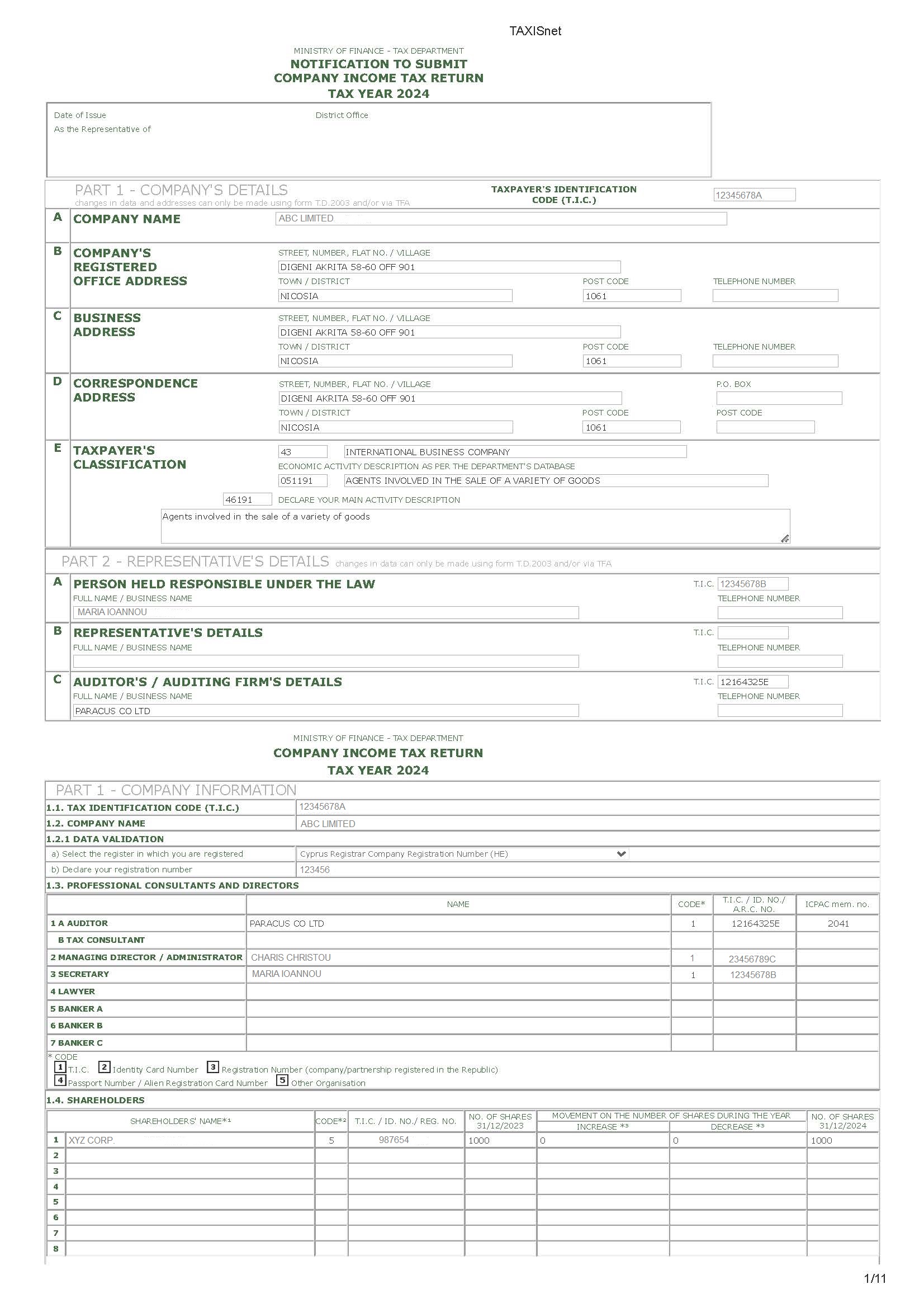
A Cyprus company tax return (Form IR4) is a document used by a corporate taxpayer to declare income and calculate tax liabilities.

Key sections of the tax return include:

  • Part 1: Company Information
  • Part 2: Company Accounts
    • Section 2.1 – Balance Sheet (assets & liabilities)
    • Section 2.2 – Profit and Loss Statement
    • Section 2.3 – Notes to the Accounts

For the purposes of the return, the completion of all the information in Part 2 is considered equivalent to the submission of accounts. However, the Tax Department reserves the right to request the accounts themselves, as well as the underlying calculations, and the company is required to present them on demand.

  • Part 3: Computation of Taxable Income
  • Part 4: Computation of Corporate Tax
  • Part 5: Special Defence Contribution

Although SDC is a distinctly different tax and is administered separately, the SDC calculations for dividends, passive interest, or rental income are included in Form IR4.

  • Part 6: Defence Contribution Withheld by Third Parties within The Republic
  • Part 7: Declaration by the Director

A statement by a company director (confirmed by their signature) declaring that all information contained in the tax return is consistent with the financial statements prepared by the board of directors and audited by the company’s auditors.

  • Part 8: Auditor’s and/or Tax Consultant’s Report

In this section, the company’s auditor formally confirms (by their signature and seal) that:

    • the figures in the balance sheet, the profit and loss statement, and the notes (Sections 2.1 to 2.3) are in agreement with the company’s financial statements for the period;
    • the sections of the tax return relating to the calculation of taxable income, corporate income tax, and SDC (Parts 3 to 5) have been checked and, in all material respects, comply with the circulars of the Tax Department;
    • the opinion expressed by the auditor on the financial statements is unqualified (without reservations).
  • Part 9: Obligations, Offences & Fines

This part is not for filling in; it is provided for informational purposes to remind the taxpayer of their liability for failure to fulfil tax obligations.

Nil Return Filing

If a company has not conducted any business in the accounting period, it is still required to file a tax return. In such cases, a so-called ‘nil’ tax return is submitted.

Tax Reporting: Value Added Tax

Tax Period

The reporting period for value added tax is the quarter.

Tax Return Filing

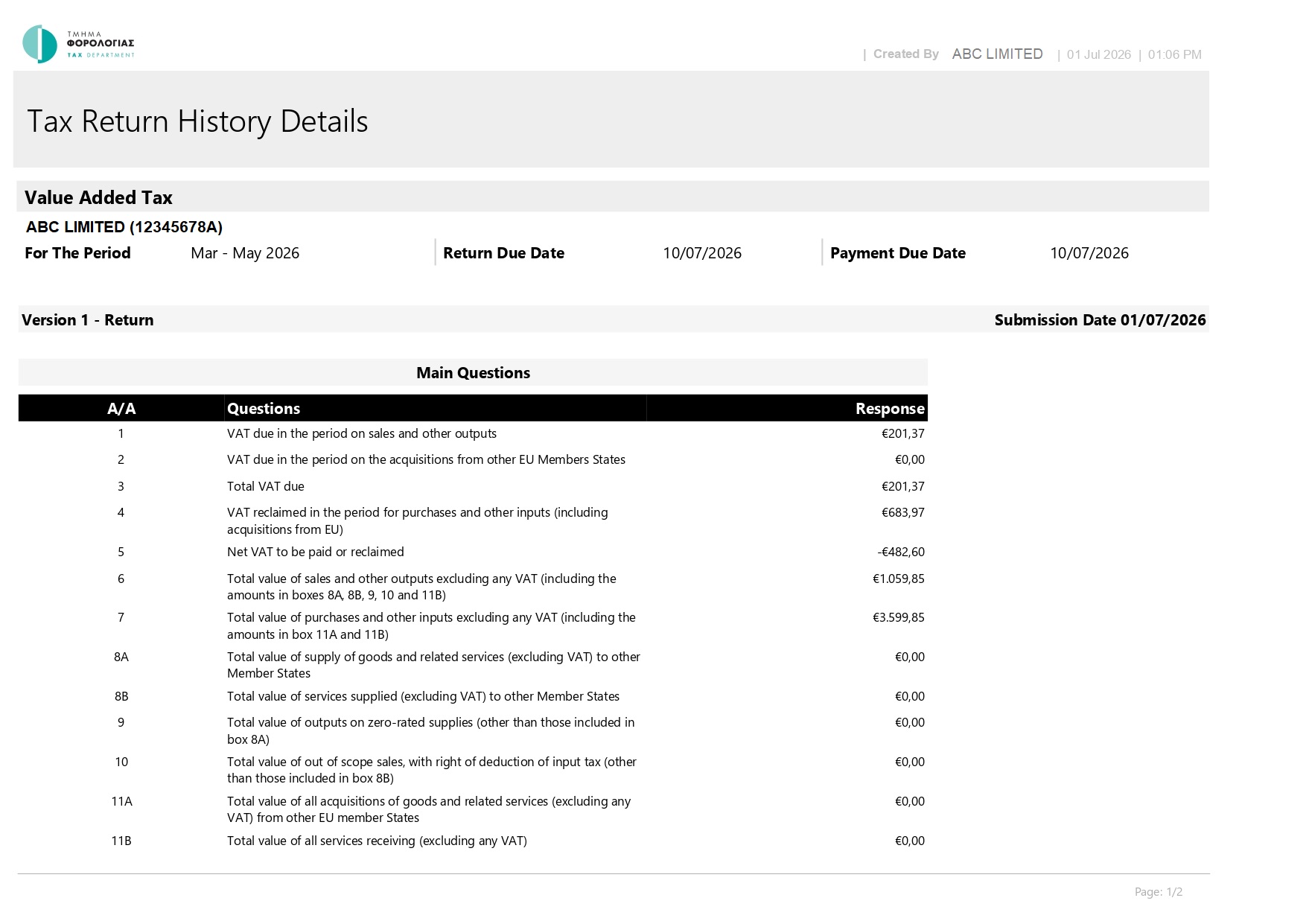
A Cyprus company is required to prepare and submit a VAT return, as well as pay any resulting tax, on a quarterly basis – by the 10th day of the second month following the end of the reporting period.

Upon request, VAT-registered entities may change their VAT return filing period, subject to approval by the tax authority.

Other Types of VAT-Related Reporting

In addition to standard VAT reporting, Cyprus requires mandatory reporting for cross-border trade with companies from other European Union member states. This reporting requirement does not apply to trade with third countries (exports to or imports from outside the EU).

VIES

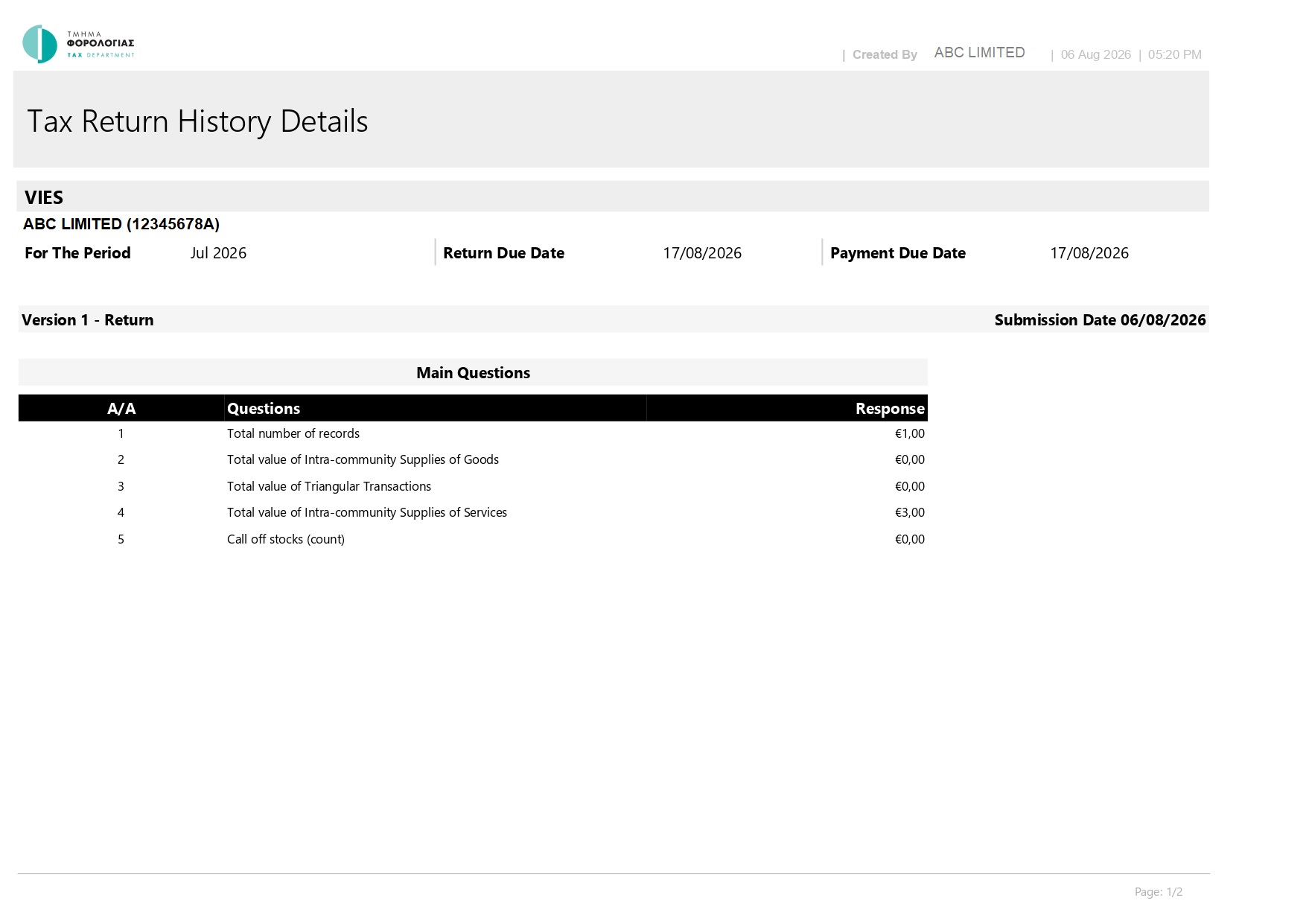
VAT Information Exchange System (VIES) tracks the supply of goods and services for VAT purposes.

If a company registered for VAT in Cyprus sells goods or services to VAT-registered entities in other EU countries, it must register with the VIES system – regardless of the transaction value – and subsequently submit VIES returns.

VIES returns must be filed on a monthly basis, within 15 days following the end of the month in which the transactions took place. Once registered in the system, a company is required to submit a return even if no reportable transactions occurred during a given month.

Main goals and objectives of VIES reporting
Monitoring trade within the EU These returns enable Cyprus tax authorities to track the VAT-exempt supply of goods and services between VAT-registered entities in different EU member states
Verifying counterparties The VIES system is used to verify the validity of a buyer’s VAT number in another EU country
Combating fraud Automated information exchange between the tax authorities of EU countries helps prevent VAT evasion schemes
Accurate VAT assessment Thanks to VIES, when supplying goods to another EU country, the seller charges 0% VAT (reverse charge), as the VAT is payable by the buyer in the country where the acquisition takes place

INTRASTAT

The INTRASTAT system is used to collect statistical data on the trade of goods within the EU. It requires VAT-registered companies to register with the system and submit reports to the Tax Department regarding the physical movement of goods between Cyprus and other EU member states, provided that the annual volume of such transactions exceeds established thresholds.

INTRASTAT applies to goods only and does not extend to services.

INTRASTAT reports must be submitted on a monthly basis – by the 10th day of the month following the reporting period – and provide details on the arrival of goods in Cyprus (Intrastat Arrivals) and/or the dispatch of goods from Cyprus (Intrastat Dispatches).

Thresholders

Thresholds ​​are set by the Cyprus government each year in accordance with EU regulations:

Year Import Export
2023 EUR 270 000 EUR 75 000
2024 EUR 320 000 EUR 75 000
2025 EUR 350 000 EUR 75 000
2026 EUR 380 000 EUR 75 000

OSS

The Cyprus One-Stop Shop (OSS) system is an upgrade to its predecessor, the Mini One-Stop Shop (MOSS). It applies to businesses that sell goods or digital services to end consumers (B2C – business-to-consumer) in other EU member states, provided that the total value of such cross-border sales exceeds EUR 10,000 per calendar year.

The system allows companies to register and submit a single quarterly VAT return covering all B2C distance sales and services across the European Union, eliminating the need to register for VAT in every individual EU country where the company sells goods or services.

Registration is required in the quarter during which the threshold is exceeded.

Starting from 2025, OSS returns must be submitted within 30 days after the end of the quarter.

Tax Reporting Forms

Liability for Tax Non-Compliance

Late filing of a tax return in Cyprus is considered an offence and entails penalties. It is also an offence to understate or conceal profits or income, or provide false information.

It should be noted that the 2026 tax reform introduces, among other things, a tiered penalty structure based on a company’s size (determined by its gross income for the preceding year). Consequently, certain penalties now vary depending on whether a company’s gross income exceeds EUR 1 million.

Offence Penalty

Corporate Income Tax

Late filing of a tax return (IR4) Before 1 January 2026: EUR 100

After 1 January 2026:

  • EUR 250 – for gross income up to EUR 1 million
  • EUR 500 – for gross income exceeding EUR 1 million
Late payment of tax A penalty of 5% of the outstanding amount (if the tax is not paid within 30 days of the last due date)
An additional penalty of 5% (if the tax remains unpaid for 2 months beyond the due date)
Penalty interest charged at an officially set annual rate – 3.5% per annum for 2026 (5.5% for 2025; 5% for 2024; 2.25% for 2023)
Understatement of provisional tax An additional charge of 10% on the difference between the provisional tax paid and the actual tax liability, if the provisional tax estimate is less than 75% of the final tax due
VAT
Late VAT registration A penalty of EUR 85 for each month of delay
Late filing of a VAT return A penalty of EUR 100 per return
Late payment of tax A penalty of 10% of the outstanding amount
Penalty interest at an officially set rate (currently 1.75% per annum)
Late filing of a VIES return A penalty of EUR 50 per return
Late filing of an INTRASTAT report A penalty of EUR 15 per report
Transfer Pricing
Failure to submit a Summary Information Table (SIT) A penalty of EUR 500
General Requirements
Underreporting income in a tax return Before 1 January 2026: CYP 2,000

After 1 January 2026: EUR 5,000

Anti-Avoidance Rules

CFC Rules

The Controlled Foreign Company (CFC) rules in Cyprus apply to:

  • companies that are tax residents of the Republic of Cyprus;
  • foreign permanent establishments of Cyprus companies (subject to certain conditions).

A foreign company may be classified as a controlled foreign company in Cyprus if the following conditions are met simultaneously:

  • the Cyprus resident company (the controlling entity) holds, directly or indirectly, more than 50% of the shares, ownership interests, or rights to the profits of the foreign company;
  • the corporate income tax rate paid by the foreign company is less than 50% of the corporate income tax rate applicable in Cyprus.

Tax will not apply to the entire profit of a CFC, but only to the portion that has not been distributed among its members, and only in proportion to the controlling company’s stake in the CFC.

The undistributed profit of a CFC may be included in the tax base of a resident company only if the CFC is an artificial (non-genuine) structure created for the sole purpose of avoiding taxation in Cyprus.

The CFC rules do not apply if the accounting profit of the controlled company does not exceed EUR 750,000 and its non-trading income does not exceed EUR 75,000, or if the CFC’s accounting profit does not exceed 10% of its operating expenses for the tax period.

Transfer Pricing

Cyprus has transfer pricing (TP) rules that govern how prices are determined for cross-border transactions between related parties. Such transactions are classified as ‘controlled transactions’ and are subject to tax oversight to ensure they align with market prices.

The primary legislation governing transfer pricing is the Income Tax Law. It empowers tax authorities to make adjustments to the income, expenses, and other financial metrics of related parties if the terms of their transactions differ from those involving independent parties and if such differences reduce the tax base.

Transfer pricing regulation in Cyprus is based on the arm’s length principle developed by the OECD. Under this principle, the terms and conditions of controlled transactions must align with those that would have been agreed upon by independent parties under the same circumstances.

Taxpayers are required to substantiate that their intercompany transactions comply with the arm’s length principle, and they must fulfil obligations regarding the preparation of transfer pricing documentation and the annual disclosure of information on controlled transactions. Specifically, as of 2024, Cyprus companies are required to submit transfer pricing reports for periods starting from 2022, provided that their transactions with related parties exceed the updated thresholds.

Transfer Pricing Documentation:

1. Documents that must be submitted

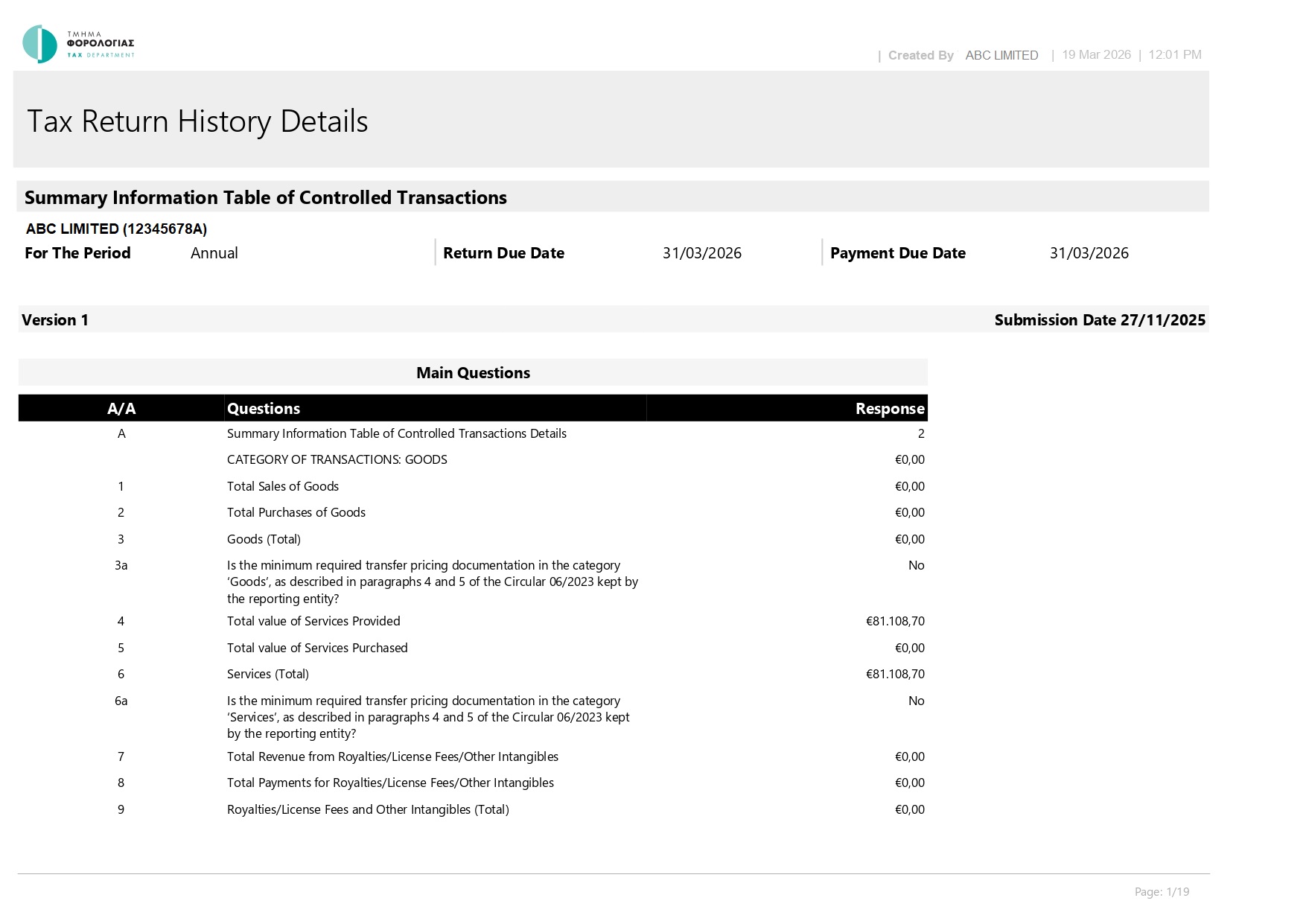
Summary Information Table

This is essentially an annual tax return for companies that engage in transactions with related parties (controlled entities with an ownership interest of 25% or more). Taxpayers are required to file this for all transactions with related parties, regardless of the transaction amount. Companies that carry out intra-group transactions must submit a Summary Information Table (SIT) along with their annual corporate income tax return. This document is completed electronically in a tabular format and submitted via Tax For All portal.

Contents
  • Counterparty details: full name, tax jurisdiction, and tax identification number (TIN)
  • Transaction type: goods, services, financial transactions, royalties/intellectual property, or other
  • Total value of transactions for each category
  • Transfer pricing method used to substantiate the arm’s-length price

The deadline for submitting the SIT to the tax authority generally coincides with the deadline for filing the corporate income tax return. Specifically, the SIT for 2024 must have been submitted by 31 March 2026; however, for the 2022 and 2023 tax periods, the standard deadline was extended on several occasions.

Late submission results in an administrative fine of EUR 500.

2. Documents that must be prepared but are submitted only upon request (within 60 days)

Local File – applicable only to companies with controlled transactions exceeding a specified threshold. Starting from the 2026 tax year, the following thresholds have been established:

  • financial transactions – over EUR 10 million
  • transactions involving goods – over EUR 5 million
  • other categories – over EUR 2.5 million
Contents
  • Description of the company’s operations (management structure, competitor analysis)
  • Description of the specific controlled transaction (details of the counterparty, terms of the transaction, influence of group companies on the transaction terms, functional analysis of the parties, market analysis)
  • Economic analysis (selection of the most appropriate transfer pricing method, including the choice of the tested party, and assessment of whether the terms of the controlled transaction are in line with market levels)

Master File – applicable only to parent companies of a multinational group with consolidated revenue exceeding EUR 750 million.

Contents
  • Group overview: organisational structure, core business activities, and significant intercompany service agreements
  • Intangible assets: key intangible assets and their owners, the group’s intellectual property strategy, and general transfer pricing policy regarding intangible assets
  • Intercompany financing: methods of group financing and policies concerning intercompany loans
  • Financial and tax data: consolidated financial statements, and advance pricing agreements (APAs) / advance tax rulings

Minimum TP Documentation) – for companies that do not submit a Local File because their controlled transactions do not exceed the established threshold (see above).

Contents
  • A brief description of the functional analysis (functions performed, assets used, and risks assumed)
  • A characterisation of the parties to the transaction, based on the results of the functional analysis
  • Justification for the selection of the most appropriate transfer pricing method
  • A comprehensive benchmarking study – an analysis in which transactions between related parties are compared against independent market data to confirm compliance with the arm’s length principle

Thin Capitalisation

Cyprus does not have thin capitalisation rules.

As of 1 January 2019, an interest limitation rule applies under the Anti-Tax Avoidance Directive (ATAD).

The interest limitation rule restricts the exceeding borrowing costs, which would otherwise be deductible for a Cyprus company or a Cyprus group of companies, to 30% of their adjusted taxable profit (tax-adjusted EBITDA).

The interest limitation rule includes an annual threshold of EUR 3 million. This means that borrowing costs up to and including EUR 3 million are, in any case, not subject to this limitation (the EUR 3 million threshold applies in instances where ‘30% of the tax-adjusted EBITDA’ results in an amount lower than EUR 3 million).

Foreign Exchange Control

There are no foreign exchange controls in Cyprus.

FAQ

When is a company considered a tax resident of Cyprus?

A company is considered a tax resident if its management and control are exercised from Cyprus.

Do Controlled Foreign Company (CFC) rules apply to companies in Cyprus?

Yes. CFC rules apply in Cyprus to resident companies that control foreign entities, provided certain conditions are met—specifically, the exercise of control and the taxation of the foreign entity’s income at rates lower than those applicable in Cyprus. CFC legislation does not apply, for instance, to companies that meet specific criteria regarding the level of their profits or the extent of their economic activity.

What taxes are levied on companies in Cyprus?

Companies in Cyprus may be subject to corporate income tax, VAT, capital gains tax, and, in certain cases, Special Defence Contribution (SDC). The standard corporate income tax rate in Cyprus is 15%.

Do transfer pricing rules apply in Cyprus?

Yes. Transfer pricing rules apply to cross-border transactions between related parties. Companies engaged in transactions with affiliates must adhere to the arm’s length principle and, upon reaching certain value thresholds for controlled transactions, are required to prepare the relevant documentation.

RU EN