

USD 750

Taxation Principle
Worldwide income for residents; territorial income for non-residents.
Tax Residency Criteria
Companies: Place of incorporation or place of effective management and control
Individuals: 183 days of physical presence or the primary center of life interests.
CFC Rules
None
Foreign Exchange Control
None
National Currency
UAE Dirham (AED)
Tax Authority

Federal Tax Department (FTA)
Tax administration in the UAE is managed by the Federal Tax Authority (FTA). The FTA is responsible for taxpayer registration, administering corporate tax, VAT, and excise tax, conducting tax audits, issuing official clarifications, and ensuring general compliance with fiscal legislation.
Beyond its domestic fiscal functions, the Federal Tax Authority ensures compliance with global transparency benchmarks, including Common Reporting Standard (CRS) mandates and economic substance rules. The FTA is also the sole body authorized to issue Tax Residency Certificates (TRC) required to utilize international Double Taxation Treaties (DTT).
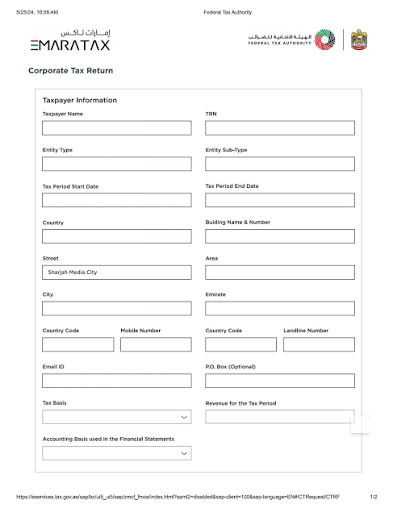
All communications, applications, and return submissions are processed through EmaraTax, the FTA’s unified digital platform, which is fully integrated with national payment channels and the UAE PASS identity verification system.
Tax Laws of the UAE
UAE tax residents are subject to corporate tax on their worldwide income.
Non-Resident entities are taxed on the income derived from sources within the UAE.
The corporate tax was introduced in the UAE on June 1, 2023, and applies to all business profits generated after this statutory date.
The taxable base is calculated based on the net accounting profit of the company, adjusted in accordance with fiscal regulations.
To qualify for the Qualifying Free Zone Person (QFZP) status, an entity must satisfy the following strict conditions:
Qualifying Free Zone Persons (QFZP) are entitled to apply a 0% tax rate to their Qualifying Income, while any other taxable income remains subject to the standard 9% rate.
Qualifying Income streams may include:
Expenses incurred wholly and exclusively for the purposes of the business and generating taxable income are deductible, unless explicitly provided otherwise by legislation. Capital expenditure is generally not fully written off immediately, but is accounted for through depreciation or amortization in accordance with applicable financial reporting standards.
When determining the taxable base for corporate tax, expenses must meet the following criteria to be deductible:
Value-Added Tax (VAT) in the UAE was introduced on January 1, 2018, and applies to the supply of goods and services, as well as to imports.
The standard rate is 5%, which represents one of the lowest rates among international tax systems.
| Rate | Applies to |
| 5% | Majority of goods and services supplied |
| 0% | Export of goods and services, international transport, designated medical and educational services, and certain investment transactions |
| Exemptions | Specific financial services, certain residential real estate transactions, and other categories explicitly provided under the legislation. |
A company is legally required to register as a VAT taxpayer if the total value of its taxable supplies and imports exceeds the statutory thresholds:
Foreign (non-resident) companies making taxable supplies within the UAE may also be subject to mandatory registration, provided there is no other person responsible for accounting for the VAT on those specific transactions.
VAT Framework for Free Zone Companies
Registration within a Free Zone does not automatically exempt a company from VAT. Free Zone enterprises must evaluate the nature of their business operations and apply VAT rules based on the specific type of their supplies.
For VAT purposes, certain Free Zone territories hold a special status known as Designated Zones. Transactions involving goods within these zones may be treated as outside the territorial scope of UAE VAT, provided specific statutory conditions are met. However, any supply of goods or services outside a Designated Zone, or transactions that do not fully comply with regulatory requirements, remain subject to the standard 5% VAT rate.
Filing and Payment
Companies registered as VAT taxpayers are required to regularly file electronic VAT returns with the Federal Tax Authority (FTA) via the official tax portal.
The standard tax period for VAT is typically 3 calendar months. However, the FTA reserves the right to assign a different period to specific categories of taxpayers.
The VAT return must be submitted and the tax paid no later than the 28th day following the end of the relevant tax period, unless specified otherwise by the FTA.
The FTA applies administrative penalties for non-compliance with VAT regulations. The primary fines associated with VAT return filings and tax payments are detailed below.
| Violation | Penalty |
| Late submission of a VAT return | AED 1,000 for the first violation;
AED 2,000 for repeated violations within 24 months. |
| Late payment of VAT declared in the return | Interest at a rate of 14% per annum, calculated on a monthly basis on the unpaid tax amount (effective from April 14, 2026) |
| Further delay in VAT payment | 1% per day of the unpaid tax amount (capped at a maximum penalty of 300% of the tax due) |
| Late VAT registration | AED 10,000 |
| Failure to maintain proper tax records and documentation | AED 1,000 for the first violation (effective from April 14, 2026);
AED 20,000 for repeated violations |
| Issuance of an incorrect tax invoice | AED 5,000 for each non-compliant document |
In the UAE, corporate dividend income is generally exempt from corporate tax; however, the tax treatment depends on the source of the dividends.
| Source of Dividends | Taxation in the UAE |
| From a UAE resident company | Exempt from corporate tax |
| From a foreign company (Participation Exemption conditions met) |
Exempt from corporate tax |
| From a foreign company (Participation Exemption conditions not met) |
Included in the taxable base and subject to standard corporate tax rates |
Dividends from foreign companies can be exempt from corporate tax provided that the conditions of the Participation Exemption regime are satisfied.
As a general rule, interest income is subject to corporate tax as it forms part of the standard taxable profit.
Free Zone Company Framework:
If the company holds Qualifying Free Zone Person (QFZP) status, interest income may:
Royalty income is generally included in the taxable profit and remains subject to standard corporate tax.
Free Zone Company Framework
For a company holding Qualifying Free Zone Person (QFZP) status, royalty income can only benefit from the preferential regime in cases explicitly provided under the legislation, specifically regarding qualifying intellectual property. In all other scenarios, such income is taxed under the standard rules.
As a general rule, capital gains realized by a company are included in the taxable profit and are subject to standard corporate tax.
Capital gains derived from the disposal of shares or other equity interests can be exempt from corporate tax, provided that the conditions of the Participation Exemption regime are satisfied.
Free Zone Company Framework
For a Qualifying Free Zone Person (QFZP), capital gains can also be subject to a 0% tax rate, provided that the gain is classified as Qualifying Income and all Free Zone regulatory requirements are satisfied. In all other cases, the standard 9% rate applies.
Withholding Tax (WHT) is 0%
There is no Stamp Duty.
The social security system in the UAE applies primarily to UAE nationals and, in specific cases, to citizens of the Gulf Cooperation Council (GCC) states. Employers are legally required to register such employees in the social security system and pay insurance contributions.
Contribution Rates for UAE Nationals:
Rates depend on the applicable pension regime. For employees covered under Federal Decree-Law No. 57 of 2023:
For employees remaining under the previous pension system, transitional rules apply with a total contribution rate of 20% of the salary (15% by the employer, 5% by the employee).
Mandatory contributions to the state social security system are not required for the vast majority of expatriate (foreign) employees. Instead of pension provisions, they are typically entitled to an End-of-Service Gratuity upon the termination of employment, in compliance with UAE labor law.
Health insurance is not integrated into the public social security system, but employers in many emirates are legally obligated to provide medical insurance for their staff. The strictest requirements are enforced in Abu Dhabi and Dubai.
A range of tax incentives and special regimes is available to legal entities in the UAE to stimulate investment and foster business development.
| Tax Relief / Incentive | Details |
| Tax-Free Corporate Income | Taxable profit up to AED 375,000 is subject to a 0% rate; profits exceeding this threshold are taxed at the standard 9% rate. |
| Qualifying Free Zone Persons (QFZP) | Companies meeting the statutory requirements can apply a 0% tax rate to their Qualifying Income. Non-qualifying income remains subject to the standard corporate tax rates. |
| Participation Exemption | Dividends received from UAE resident companies and from qualifying foreign subsidiaries are exempt from corporate tax, subject to specific statutory conditions. |
| Capital Gains Exemption | Revenues derived from the disposal of shares or equity interests in qualifying companies can be exempt from corporate tax, subject to regulatory requirements. |
| Intra-Group Transfer and Reorganization Relief | The law provides corporate tax exemptions for specific intra-group asset transfers and business reorganization transactions, provided established conditions are satisfied. |
| Small Business Relief | Entities with an annual gross revenue not exceeding AED 3,000,000 can elect to be treated as having no taxable income for the relevant tax period. This relief is subject to statutory conditions and is currently available for tax periods ending on or before December 31, 2026. |
| Exempt Persons and Entities | Government entities, extractive businesses (subject to conditions), qualifying public benefit organizations, pension and social security funds, qualifying investment funds, and certain other categories of taxpayers are exempt from corporate tax. |
| Foreign Tax Credit | Tax paid in a foreign jurisdiction on foreign-sourced income can be credited against the UAE corporate tax liability within established statutory limits, preventing double taxation. |
| Tax Groups | Eligible companies can form a single Tax Group and file a unified corporate tax return, simplifying tax administration and allowing the offsetting of profits and losses across group members. |
All persons recognized as corporate taxpayers in the UAE are legally required to register with the Federal Tax Authority and obtain a Corporate Tax Registration Number (CT TRN). This mandate applies equally to Mainland enterprises and Free Zone Persons.
Registration is processed electronically via the EmaraTax system.
To secure a Corporate Tax Registration Number, the following documentation is typically required:
The UAE framework mandates a single annual Corporate Tax Return. The return must be completed and submitted exclusively in electronic format via the Federal Tax Authority (FTA) portal (EmaraTax).
There are no provisions for advance tax estimates, provisional returns, or monthly/quarterly corporate tax filings.
The tax return submission and the actual tax payment share the same deadline — no later than 9 months following the end of the relevant tax period.
The tax return must reflect:
Violation
Penalty
Late registration for corporate tax
AED 10 000
Late submission of a corporate tax return
Late payment of corporate tax
Interest at a rate of 14% per annum on the unpaid tax amount for each month (or part thereof) of delay.
Late submission of a tax deregistration application
AED 1,000 for each month of delay, capped at a maximum of AED 10,000
Late notification of the appointment of a legal representative
AED 1 000
There are no capital movement restrictions or traditional foreign exchange controls in the UAE.
However, all foreign exchange transactions are conducted subject to strict banking regulations, anti-money laundering (AML) legislation, and Know Your Customer (KYC) compliance procedures. Banks and financial institutions reserve the right to request supporting documentation verifying the economic substance and source of funds for any transaction.
Transfer pricing rules in the UAE are based on the OECD Transfer Pricing Guidelines and apply to transactions executed between related parties and connected persons.
All controlled transactions must comply with the Arm’s Length Principle. This requires transactions between interdependent entities to be conducted under terms and conditions comparable to those that would be agreed upon by independent parties under similar circumstances.
To verify compliance with the arm’s length principle, the following OECD-recommended methods are applied:
Taxpayers are required to demonstrate that their controlled transactions adhere to the arm’s length principle.
UAE legislation mandates a three-tier transfer pricing documentation system aligned with OECD requirements (BEPS Action 13):
Furthermore, the largest multinational enterprise (MNE) groups are subject to the obligation of submitting a Country-by-Country Report (CbCR).
| Document | Who is Required to Prepare | When to Prepare / Submit |
| Transfer Pricing Disclosure Form | Taxpayers executing controlled transactions, provided that:
|
Submitted together with the annual Corporate Tax Return. |
| Local File | Taxpayers that meet either of the following criteria:
|
Prepared annually and maintained by the taxpayer. Submitted strictly upon request by the FTA, typically within 30 days. |
| Master File | The same taxpayers that are required to prepare a Local File. | Prepared annually and maintained by the taxpayer. Submitted upon request by the FTA within 30 days. |
| Country-by-Country Report (CbCR) | The ultimate parent entity of an MNE group that is a UAE tax resident, provided that the group’s consolidated revenue is AED 3.15 billion (~ EUR 750 million) or more. | Submitted annually, no later than 12 months following the end of the reporting financial year. |
Even if a taxpayer is not statutorily required to maintain a Master File and a Local File, the FTA retains the legal right to request documentation proving that its controlled transactions adhere to the arm’s length principle. Therefore, it is highly recommended to maintain supporting documentation for all such transactions, regardless of whether the established thresholds are met.
Liability for Non-Compliance
| Violation | Penalty |
| Failure to submit the Transfer Pricing Disclosure Form with the tax return |
|
| Failure to maintain or submit the Local File and Master File upon request by the FTA |
|
Instead of traditional thin capitalization rules, the UAE implements interest deduction limitation rules based on the OECD BEPS Action 4 framework.
Interest expenses derived from debt financing can be deducted for taxable profit calculation purposes only up to a limit of 30% of EBITDA (earnings before interest, taxes, depreciation, and amortization).
This restriction does not apply if the total net interest expenditure for the relevant tax period does not exceed AED 12,000,000.
Beyond the general interest capping rule, specific regulations govern transactions with related parties. Interest on loans obtained from related parties may be disallowed for tax deduction purposes if the loan proceeds are utilized for:
The UAE ranks among the global leaders in the volume of its international tax treaty network.
Over 140 Double Taxation Avoidance Agreements (DTAA) have been signed.
This extensive network of treaties enables multinational holding structures to substantially mitigate their tax burdens on cross-border income flows, such as dividends, interest, and royalties, while guaranteeing robust capital protection against double taxation.
Yes, registration with the Federal Tax Authority is mandatory for absolutely all UAE companies, including Free Zone structures and even loss-making entities. Regarding tax payments, Free Zone companies can qualify for a preferential 0% rate upon satisfying certain conditions (earning Qualifying Income, maintaining audited financial statements, and ensuring economic substance). If these regulations are violated, profits are taxed at the standard 9% rate.
Mandatory registration as a VAT taxpayer (5% rate) is required if a company’s taxable turnover over the past 12 months (or forecast for the next 30 days) exceeds AED 375,000. Voluntary registration is also available once the turnover reaches AED 187,500.
Yes. Under the corporate tax law, all legal entities must maintain proper bookkeeping records in compliance with IFRS and retain primary documentation for at least 7 years. An annual independent audit is strictly mandatory for companies whose revenue exceeds AED 50,000,000, as well as for all Free Zone entities without exception that wish to retain their 0% tax rate.
The UAE does not impose a personal income tax (PIT). Individuals, whether UAE nationals or expatriate residents, are completely exempt from tax on salaries, wages, bonuses, investment returns, or any other personal income streams.
However, an individual may become subject to corporate tax if they conduct independent entrepreneurial or business activities within the UAE.
Corporate tax applies to business income derived from sources within the UAE or from foreign sources (provided the activity is linked to a business in the UAE) and the total annual revenue from such activity exceeds AED 1,000,000.
The following personal income streams are strictly excluded from the revenue calculation and are not subject to corporate tax:
Real Estate Tax
There is no ongoing property or real estate tax in the UAE. However, registration and administrative fees may apply upon the purchase or transfer of real estate.
Property Transfer Fee
This fee applies to the sale of real estate and, in certain cases, to the transfer of shares in companies that own real estate in the UAE:
Property Rentals
Certain emirates levy municipal fees (Housing Fee).
In Dubai, this fee is 5% of the annual rental value for residential properties and 10% for commercial real estate. The fee is automatically split and included in the monthly utility bills issued by the Dubai Electricity and Water Authority (DEWA).
Dividend and interest income received by an individual is not subject to taxation in the UAE, as the country imposes no personal income tax.
The UAE does not levy a separate capital gains tax or personal income tax on individuals.
The social security system in the UAE applies primarily to UAE nationals and, in specific cases, to citizens of the Gulf Cooperation Council (GCC) states. Employers are legally required to register such employees in the social security system and pay insurance contributions.
Contribution Rates for UAE Nationals:
Rates depend on the applicable pension regime. For employees covered under Federal Decree-Law No. 57 of 2023:
For employees remaining under the previous pension system, transitional rules apply with a total contribution rate of 20% of the salary (15% by the employer, 5% by the employee).
Mandatory contributions to the state social security system are not required for the vast majority of expatriate (foreign) employees. Instead of pension provisions, they are typically entitled to an End-of-Service Gratuity upon the termination of employment, in compliance with UAE labor law.
Health insurance is not integrated into the public social security system, but employers in many emirates are legally obligated to provide medical insurance for their staff. The strictest requirements are enforced in Abu Dhabi and Dubai.
There are no separate inheritance or gift taxes in the UAE.
The UAE provides a range of significant tax advantages for individuals, establishing the country as one of the most attractive jurisdictions globally for residence and investment.
Salaries, wages, bonuses, self-employment income (unless triggering a corporate tax liability), investment returns, and most other personal income streams are completely exempt from taxation.
Personal profits derived from the sale of securities, equity stakes, and other personal assets are generally non-taxable. Separate rules may apply if the individual conducts independent business activities subject to corporate tax.
Dividends and interest received by individuals as personal investment income are fully exempt from tax.
The UAE does not levy federal taxes on inherited assets or financial gifts.
Holding real estate does not incur ongoing annual property taxes, though one-time registration fees apply upon purchase, and municipal or maintenance charges may be levied.
As there is no personal income tax framework, individuals are not required to register with tax authorities or file returns on their personal income. However, those conducting entrepreneurial activities that trigger corporate tax or VAT thresholds must fulfill corresponding compliance duties.
Tax residents of the UAE can utilize the benefits of international Double Taxation Avoidance Agreements (DTAA), subject to satisfying the conditions of the respective treaties.
No Stamp Duty.
No CFC Rules.
Upon reviewing the application, the Federal Tax Authority (FTA) confirms the registration and assigns a Tax Registration Number (TRN), which is used for the following purposes:
If an individual conducts business activities that fall within the scope of corporate tax, they are required to register with the Federal Tax Authority and obtain a Tax Registration Number (TRN).
Registration is completed online via the EmaraTax digital portal. The individual sets up a profile using:
Once the profile is created, the taxpayer must file an application specifying:
The following supporting documents are typically required:
Following the review and approval of the application, the FTA confirms the registration and issues a unique Tax Registration Number (TRN).
This tax number must be utilized for filing corporate tax returns, liaising with the state tax authorities, and fulfilling all other statutory tax obligations.
No, the UAE does not impose any personal income tax. Salaried employees receive their wages in full without any fiscal deductions. Similarly, freelance income is completely tax-exempt, provided it does not qualify as regular entrepreneurial activity exceeding the statutory threshold of AED 1,000,000 per calendar year.
No. The UAE levies no taxes on capital gains, personal investment dividends, bank deposit interest, inheritance, or gifts. When trading or leasing real estate, individuals are not subject to income tax; however, they must pay a one-time registration fee to the Land Department of the respective emirate (e.g., 4% of the property value in Dubai).
An individual is recognized as a UAE tax resident if they reside legally in the country (holding a valid residency visa and a tenancy contract or property title deed) and meet specific physical presence criteria. This requires spending 183 days or more in the UAE within a consecutive 12-month period, or at least 90 days if the UAE serves as the primary center of their financial and personal interests. To apply international treaties, one must request an official Tax Residency Certificate (TRC) via the EmaraTax portal.