1.
Private Company Limited by Shares
The most common corporate form for small and medium-sized businesses. Shareholders are only liable to the extent of their capital contributions. Shares cannot be freely offered to the general public.

A reputable onshore jurisdiction that inspires confidence among banks and foreign partners; not on FATF or OECD lists of non-cooperative jurisdictions
A company is formed remotely (without you having to travel to the UK) and in a very short time frame
Directors and shareholders can both be non-residents, and the initial share capital can be as little as GBP 1
Using a limited liability partnership (LLP) makes it possible to legally avoid tax provided business operations are conducted outside the country
The English (common) law system based on precedent provides predictable and effective protection for assets, investors and owners’ rights
Most UK payment institutions are far more willing to work with UK-registered companies, although UK registration alone is not sufficient
Even a very basic structure requires significant annual investment
All directors and beneficial owners of a company are required to undergo a rigorous identity verification. Plus, the details of ultimate beneficial owners are fully public and accessible free of charge
An individual conducts business and bears full personal liability for obligations.
A business conducted jointly by two or more partners, all of whom have unlimited personal liability for the partnership’s obligations. It does not constitute a separate legal entity and is governed by the Partnership Act 1890.
Consists of at least one general partner who has unlimited liability and manages the business, and one or more limited partners who have limited liability and no management authority. This structure is not a separate legal entity and is governed by the Limited Partnerships Act 1907.
Consists of at least two partners all of whom have limited liability and may participate in managing the business on equal terms. It is a separate legal entity with its own legal personality. Like companies, this type of partnership must annually file a confirmation statement and financial statements with the Registrar.
This term covers both branches and places of business of foreign companies. A UK establishment is not a separate legal entity and shares liability with the parent company. Its setup, operation, and closure in the United Kingdom are governed by the Overseas Companies Regulations.
A legal arrangement for holding and managing assets for the benefit of beneficiaries. It is used in private wealth management and estate planning.

Whether a proposed company name is available can be checked free of charge via the online Company name availability checker at Companies House. It is also advisable to check the name by doing a search in the trade mark database.
Minimum 1 director
Individual or corporate
! At least one director must be an individual
Resident or non-resident
Director’s details are provided to the local agent and entered into the public register
Minimum 1 shareholder
Individuals and corporate entities, residents or non-residents
A sole shareholder can also act as director of the company
Shareholder’s details are provided to the local agent and entered into the public register
This position is optional, not mandatory
Individual or corporate entity
Resident or non-resident
If a secretary is appointed, their details are provided to the local agent and entered into the public register
Details of beneficial owners who fall under the definition of ‘persons with significant control’ (PSC) are entered into the public register
Minimum 2 designated members
Individuals or corporate entities
Residents or non-residents
Details of designated members are entered into the public register
! If there are fewer than two designated members, then every member is deemed to be a designated member.
! Unlike ordinary members, designated members have additional administrative responsibilities, similar to those of a director in a company: they submit accounts and confirmation statements to Companies House and notify it of any changes, etc.
No minimum number
Individuals or corporate entities
Residents or non-residents
Details of members are entered into the public register
There is no secretary in limited liability partnerships under UK law
Details of beneficial owners who fall under the definition of ‘persons with significant control’ (PSC) are entered into the public register
A person with significant control is a person who meets any one or more of the following criteria:
Using nominees does not help to conceal actual ownership. The law requires disclosing the person exercising ultimate/actual control.
This information (personal data) is not fully disclosed in the public register: the home address is completely shielded, and the date of birth shows just the month and year. The full data is only accessible to government authorities and credit reference agencies.
If a company has not identified any individuals who meet the PSC criteria, it must tell Companies House so by submitting the appropriate statement. The statement must explain why there are no PSCs or the reason why their identity could not have been verified.
From 18 November 2025, mandatory identity verification has been introduced for directors and beneficial owners (persons with significant control) of UK companies. These individuals must complete an identity verification process for Companies House in one of two ways:
Upon successful verification, each individual receives a unique identifier – a personal code for Companies House. This code consists of 11 characters and is strictly personal, i.e. it is assigned specifically to the individual rather than to the company.
PSCs are given 14 days to complete their identity verification. However, the start of this 14-day period depends on several factors.
The personal code must be provided separately for each role. As a director, the individual must provide the code in the company’s confirmation statement. As a PSC, they must provide the code within 14 days following the date of the confirmation statement. If the company files the confirmation statement early, the dates of the 14-day period remain unchanged.
The personal code must be provided within the first 14 days of their birth month. For example, if the date of birth is 22 January, the 14-day period will begin on 1 January.
The personal code must be provided when the individual is first added to the Companies House register, or within 14 days of being added.
The time frame for completing verification is now inextricably linked to the deadline for PSC register filing: both must be completed within a 14-day period. It is not possible to submit details of a new beneficial owner without first undergoing identity verification; doing so would result in either a refused filing or penalties for non-compliance.
Companies are also allowed 14 days to notify the Registrar of any changes to the details of their existing PSCs (such as a change of address or level of shareholding).
However, there is no requirement to file the PSC register as a standalone document on an annual basis. Instead, by annually submitting a confirmation statement, the company verifies that all public information about it, including details of beneficial owners, is correct and up to date.
Regarding the PSC register, all parties have their respective obligations:
Company directors face liability in the form of fines (with no upper limit) and/or potential imprisonment for up to 2 years. For the company, the consequences include fines and/or potential strike-off from the register.
They will be liable to a fine and/or 2-year prison sentence.
As an additional measure, if the beneficial owner fails to respond to the notice, the company may issue a warning allowing one month to comply; if there is still no action, the company is entitled to impose restrictions that will limit the exercise of rights in respect to the shares or interest. In such a case, the beneficial owner will be unable to transfer their interest, vote, or receive dividends.
The UK became the first country in the world to make beneficial ownership data fully transparent and freely accessible to the public. While the European Union began restricting public access to its registers following 2022 court rulings due to privacy concerns, the UK has, on the contrary, consistently strengthened its transparency laws.
The only details withheld from the public is the beneficial owner’s home address and the day in their date of birth. This protected information is disclosed exclusively to:
Information can be fully shielded only in exceptional cases where the beneficial owner demonstrates that public disclosure poses a threat to their physical safety (such as a risk of violence or kidnapping); however, this requires navigating a rigorous approval process with Companies House. If a beneficial owner applies for data protection, disclosure of data ceases from the date the application is submitted.
The UK legal system is based on common law, statutes, and judicial precedents.
Regulations governing corporate matters, taxation, financial markets, compliance, and other aspects of business are transparent and predictable, ensuring a high level of protection for property rights and investors. English law is also widely used in international transactions and arbitration.
The most common forms are:
The name of both types of entity must consist solely of characters from English (i.e. essentially the Latin alphabet) and Welsh (standard Latin characters with modifications); it must be unique and must not be misleading.
The company name must also comply with the requirements of the Companies Act 2006, whilst the name of a partnership must comply with the requirements of the Limited Partnerships Act 2000 and the Limited Liability Partnerships (Application of Companies Act 2006) Regulations 2009.
A UK company formation agent (trust or company service provider / TCSP) is required under the terms of its licence to run a compliance check on individuals and legal entities within the structure of the companies/partnerships under its administration. This entails collecting KYC documents relating to company directors and shareholders, partnership members, attorneys (where a power of attorney is required), and beneficial owners.
To register a company, a set of documents must be prepared:
LTD
The Memorandum of Association of a UK limited company must use the wording and format prescribed by the Companies (Registration) Regulations 2008. This is an extremely brief document which confirms the subscribers’ intention to set up a company and become its members, and, for companies with authorised share capital, to subscribe for at least one share each.
Any alterations or additions to the Memorandum of Association will result in the refusal of registration.
The Articles of Association are the company’s internal rulebook binding on the company and its members: the procedure for decision-making by members and directors, the regulation of shares, and so on. When establishing a company, you can choose to adopt: model articles in full, model articles with amendments (these amendments must be attached to the application), or your own bespoke articles (the full text must be attached). Unless otherwise specified, the model articles for the relevant type of company are applied automatically. They are not mandatory, but are suitable for most standard companies and can provide useful guidance.
The physical form needs to be provided only when submitting by post a paper application to incorporate a company. For online registration, the process is significantly simplified, although it still technically uses the IN01 data structure.
Form IN01 includes the following information:
LLP
The only document submitted to Companies House. The form includes the following information:
The Limited Liability Partnership Agreement (LLP Agreement) is not legally mandatory but is practically essential when establishing this type of entity. The agreement helps to protect the members’ investments and clarifies operational matters by defining, among other things:
| LTD | LLP |
| Documents are filed in one of the following ways: | |
| Using commercial software an applying digitally (often through company formation agents or web services) | Electronically using the appropriate software |
| Online using the GOV.UK service – the company is simultaneously registered with HMRC for corporation tax |
— |
|
By post in paper form |
|
| Registration fees are payable upon application: | |
|
Via a commercial online service / Electronically – GPB 100 (standard); GPB 156 (same day incorporation) |
|
| Via government web service – GPB 100 |
— |
|
By post – GPB 124 |
|
After the application is reviewed and approved, Companies House issues a Certificate of Incorporation, an official legal document confirming the establishment of a company or a limited liability partnership. The certificate shows:
Incorporation time:
| LTD | LLP |
| For use outside the UK (e.g., with banks or foreign partners), the key corporate documents are apostilled. The post-incorporation package usually includes apostilled copies of the following documents: | |
|
|
| The originals of these documents, with the exception of the power of attorney, are not apostilled. Likewise, the following documents are also handed over to the client unaposilled, as originals: | |
|
|
If a company or partnership plans to do business that requires an authorisation or licence (banking, insurance and financial services, education and healthcare, tourism, transport, etc.), it must first apply for such authorisation or licence.
| LTD | LLP |
| Companies House notifies HMRC of the incorporation of a new company. After approximately 3 weeks, HMRC will send a letter to the company’s registered office containing its Unique Taxpayer Reference (UTR) and instructions on how to register for corporation tax.
The company must notify HMRC that it has commenced trading within 3 months. |
When a partnership is incorporated by Companies House, it is automatically registered under the Self-Assessment scheme. After approximately 3 weeks, HMRC will send a letter to the LLP’s registered office containing its Unique Taxpayer Reference (UTR). |
In order to truly become operational, a company/partnership opens a bank account:
Once the account is opened, a company/partnership can operate fully, make transactions and payments with counterparties and clients.
The total cost of incorporation consists of registration fees, annual maintenance fees (payable one year in advance at the time of registration), legalised corporate documents package, and courier delivery to the destination.
Payable in cases of: company registration, company renewal, company liquidation, transfer to a new agent, issuance of a Power of Attorney to a new attorney, change of director / shareholder / beneficial owner (except for changes to a nominee director / shareholder), signing of documents
The law does not require a founder to register a company through a specially licensed formation agent. However, in practice, engaging such specialists significantly simplifies the process because the agent:
This is precisely why it is common practice to use the services of professional TCSPs whose activities are regulated to ensuring a high standard and quality of service and minimize the risk of fines.
Choosing us as your regulated provider means that:
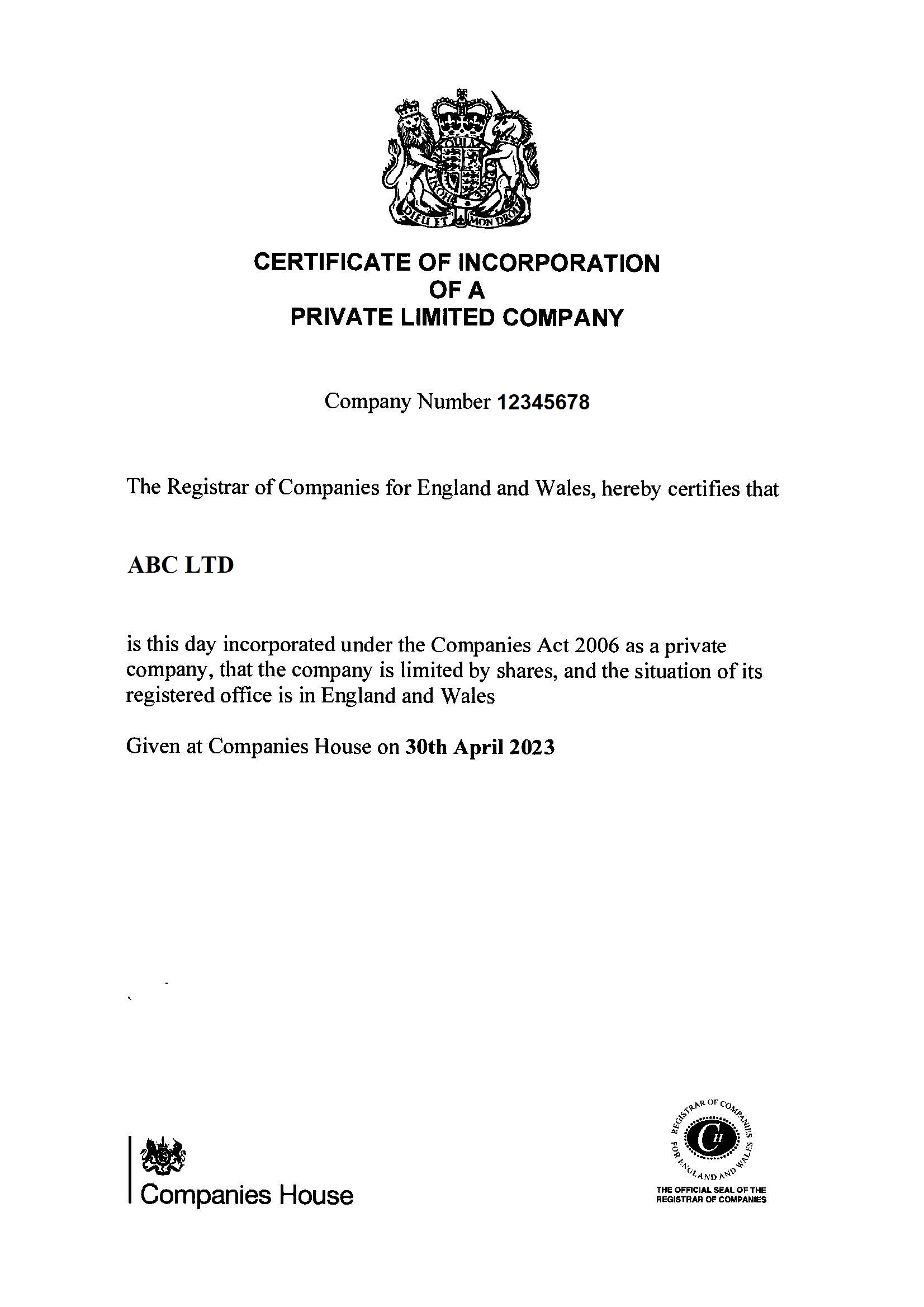
Confirms that the company is registered under the Companies Act 2006.
Issued by Companies House.
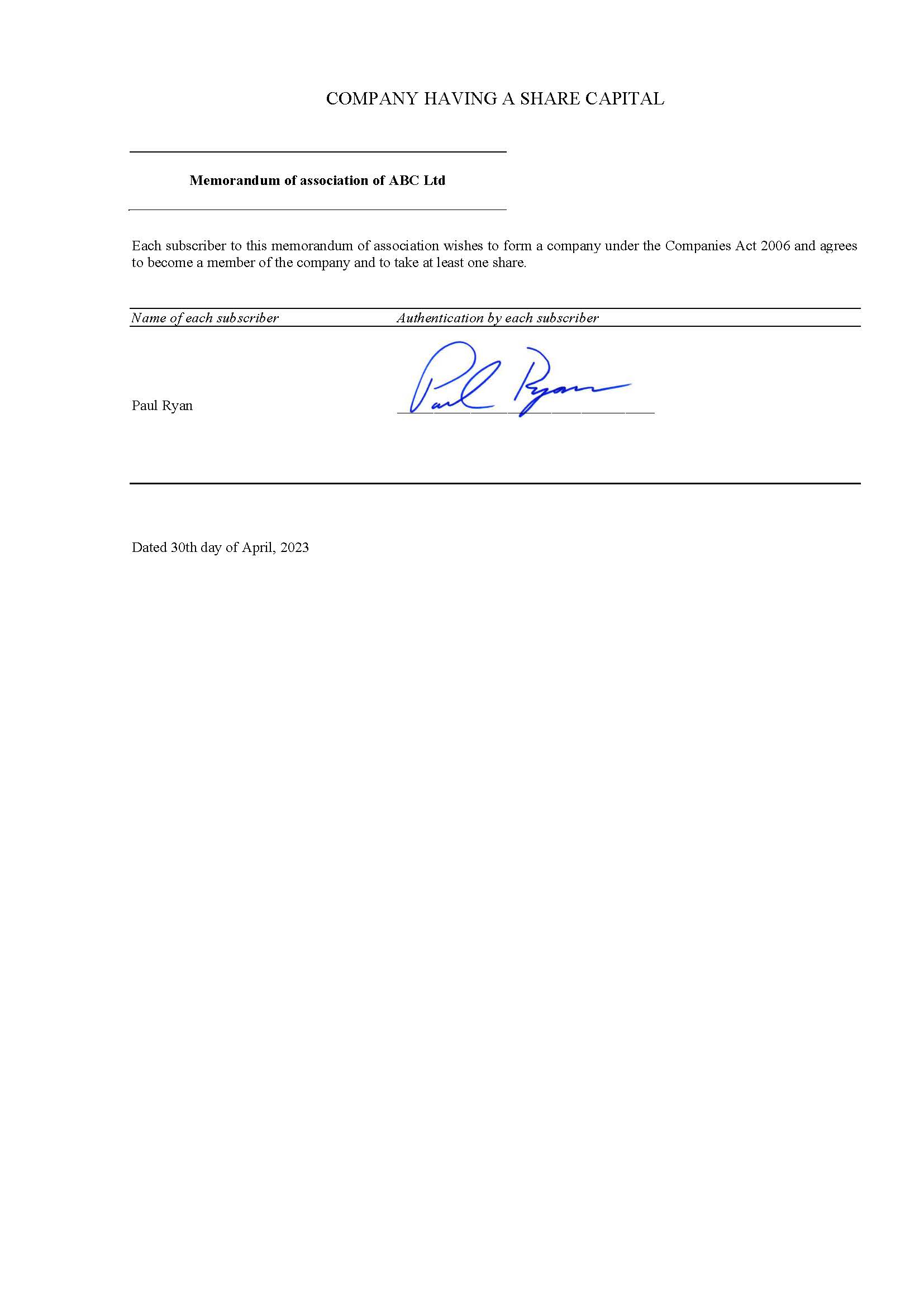
Must use the prescribed wording and format; otherwise, the company’s registration will be refused. Confirms the subscribers’ intention to form a company and become its members – and, for companies with share capital, to acquire at least one share each.
Signed by the subscribers and filed with Companies House.
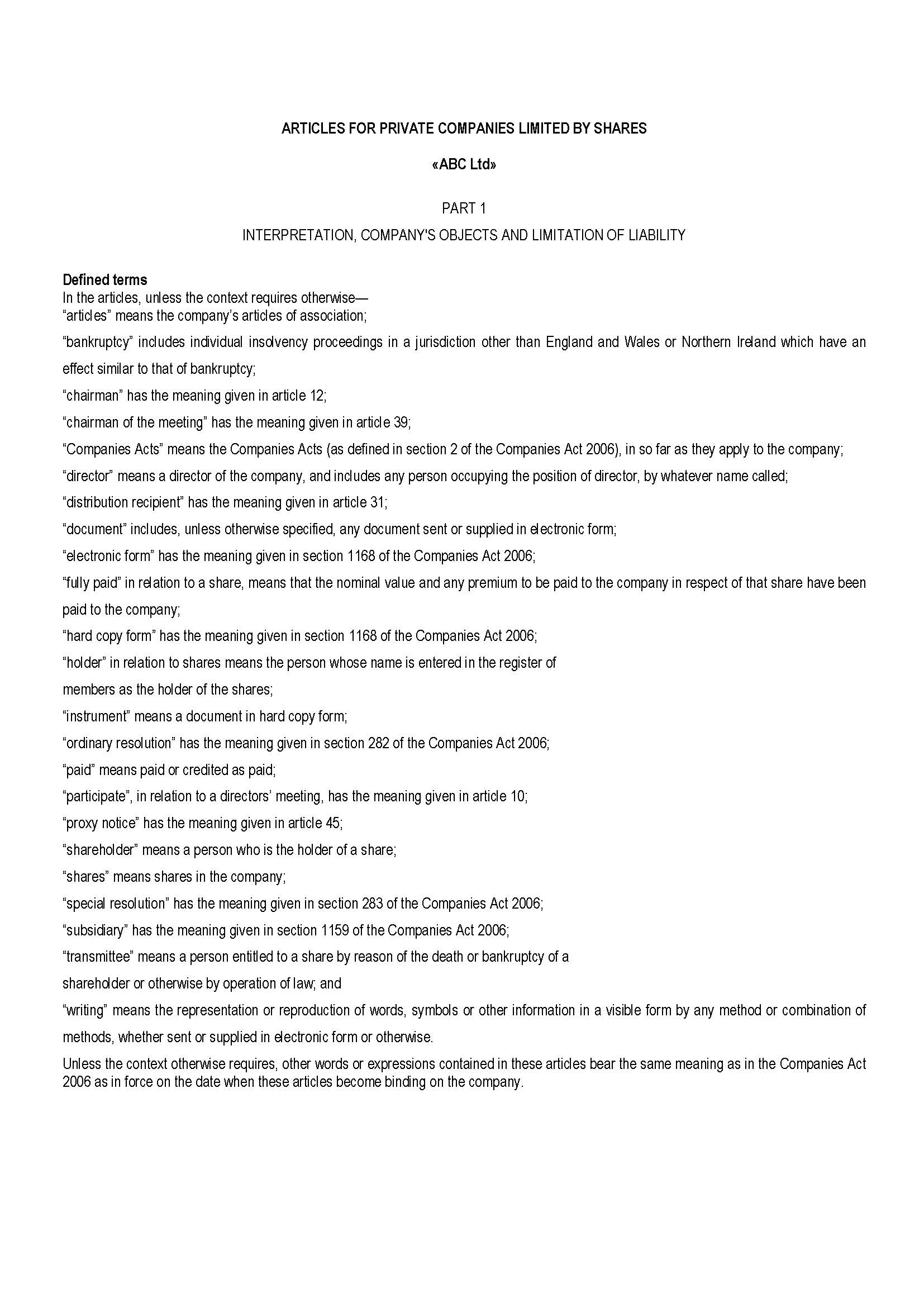
Set out the rights and obligations of the company’s directors and shareholders, and the procedures for making corporate decisions. Can use the standard form, a standard form with modifications, or a bespoke version.
Signed by the subscribers and filed with Companies House.
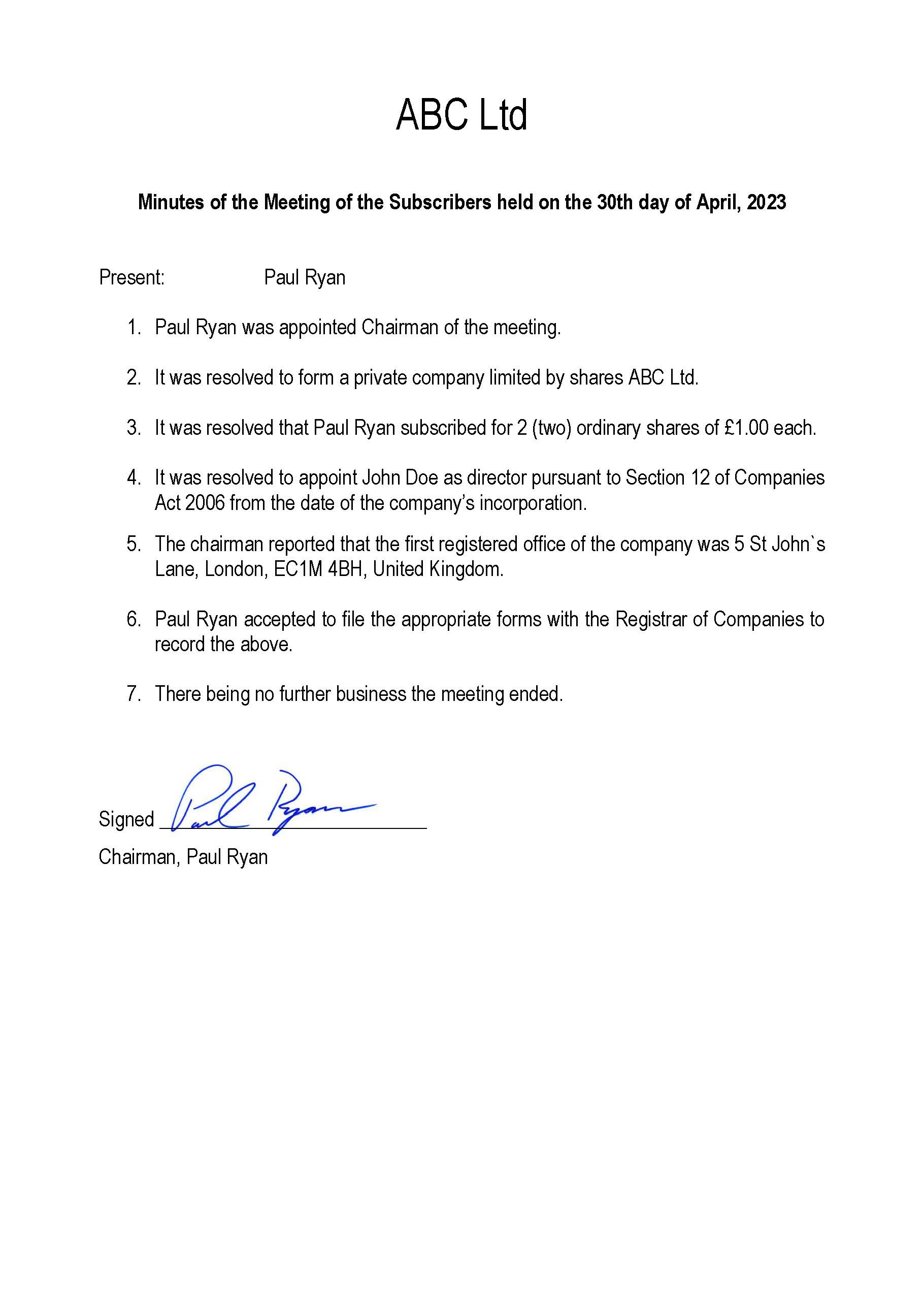
Confirm that the subscribers met to establish the company and determined its future structure: name, registered office, authorised capital and allocation of shares, and director.
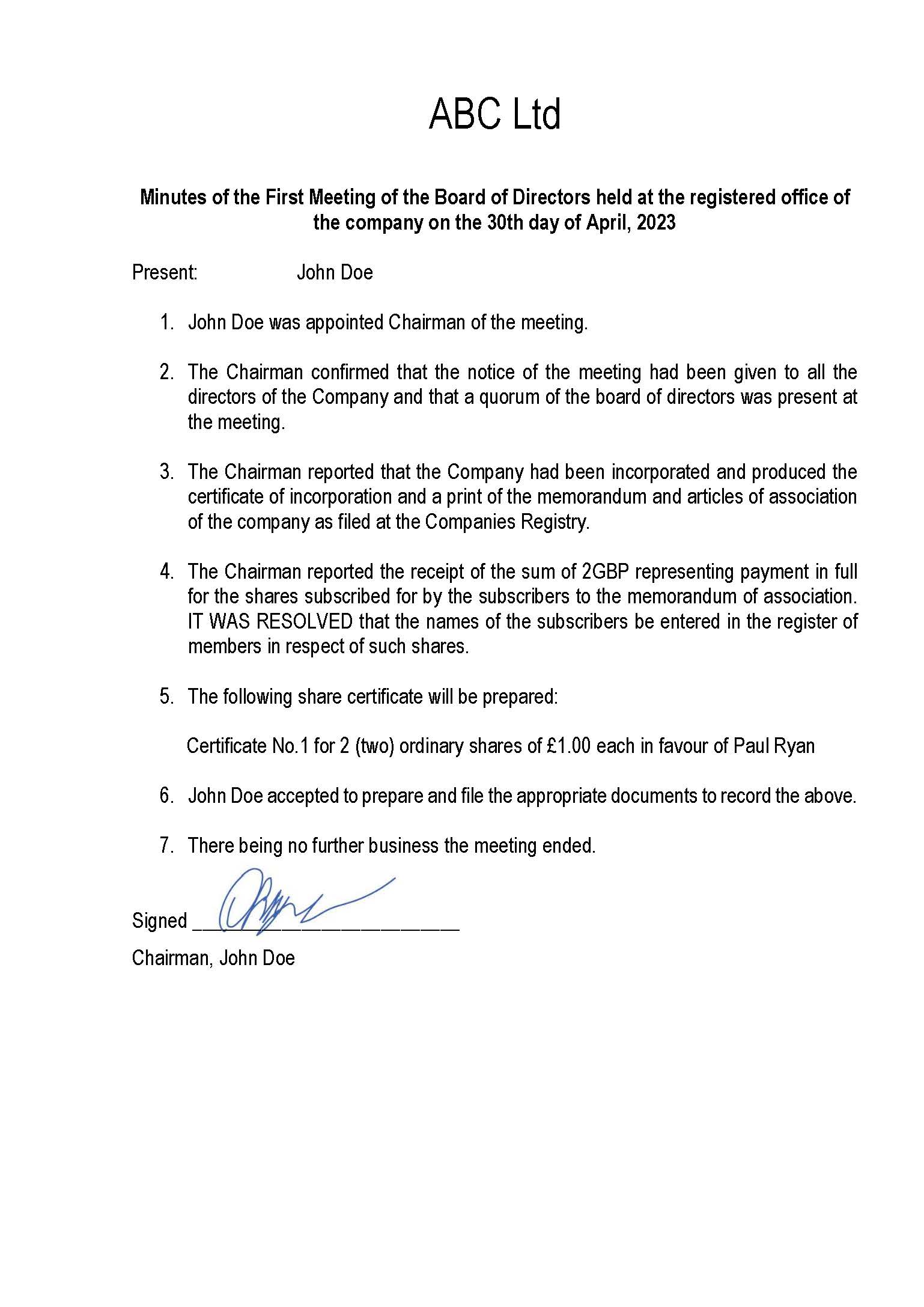
Record the registration of the company and presentation to the meeting of the Certificate of Incorporation and constitutive documents filed with Companies House; also confirm receipt of payment for the shares and issue of share certificates.
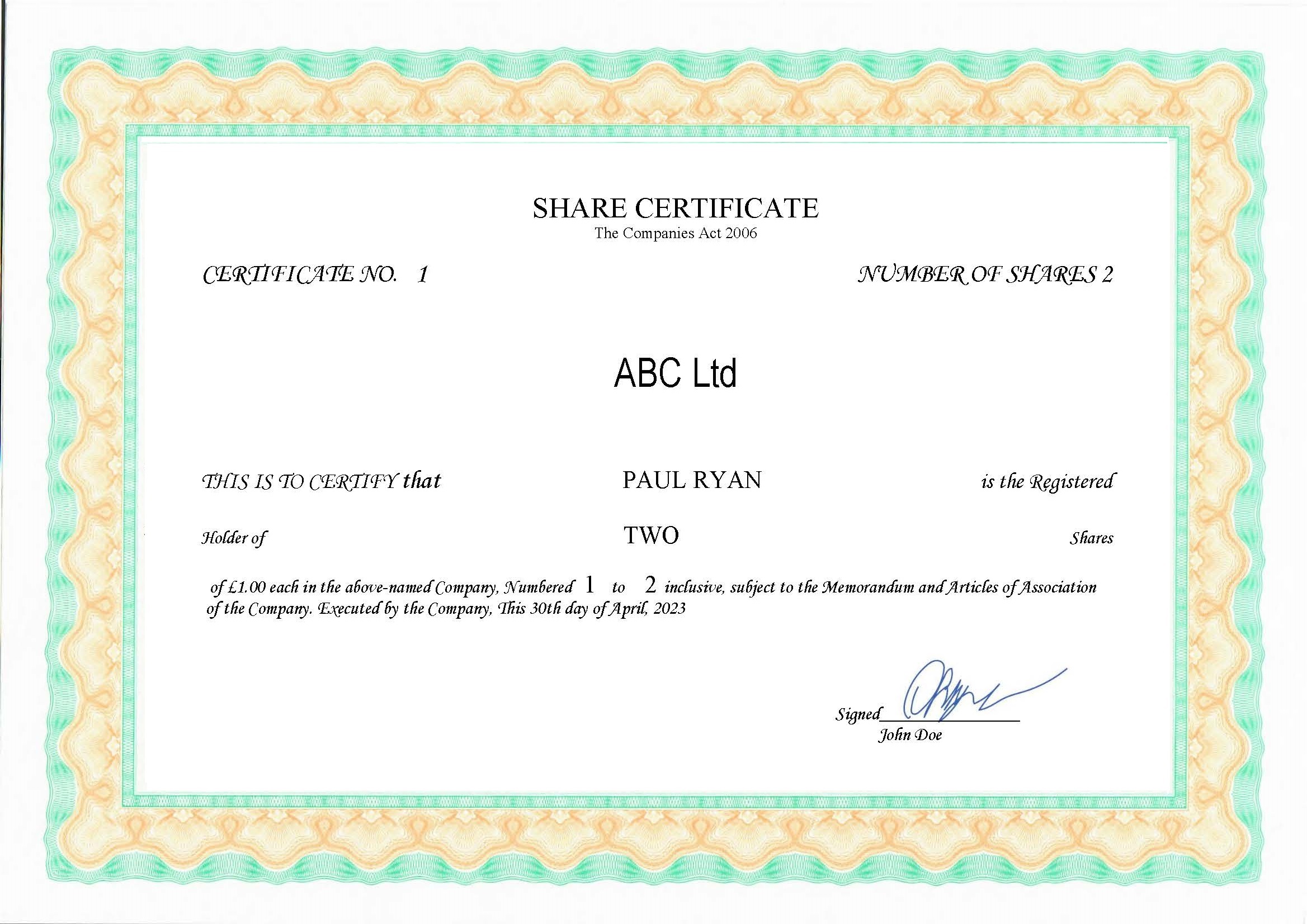
Confirms a shareholder’s ownership of the specified number of shares.
Issued by the company and signed by its directors or authorised persons.
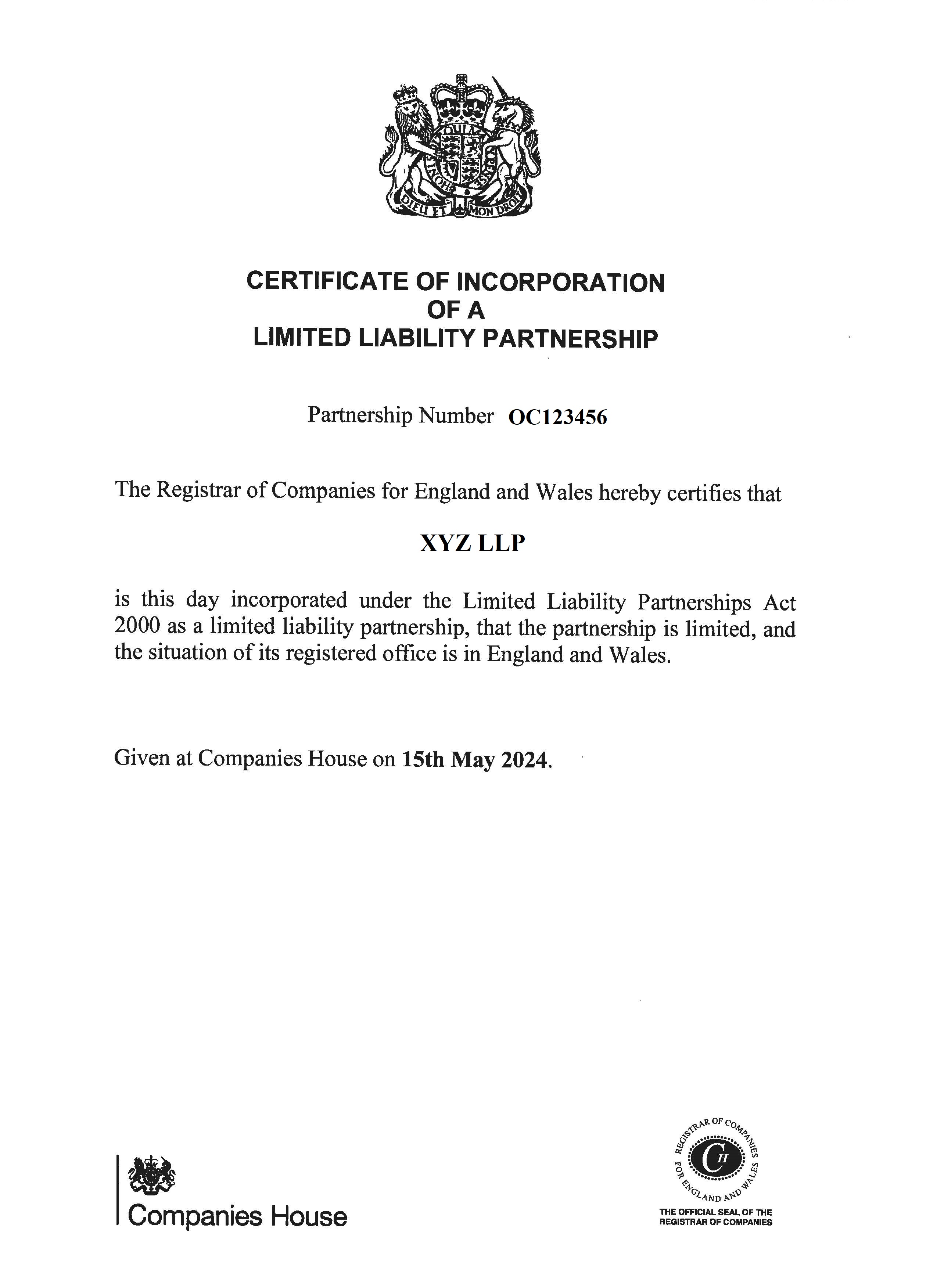
Confirms that the partnership is registered under the Limited Liability Partnerships Act 2000.
Issued by Companies House.
Defines key aspects such as the distribution of profits among the partners, the partnership’s decision-making procedure, and the terms for withdrawal from and dissolution of the partnership.
Not required to be filed with Companies House and remains a private, confidential document for the partners.
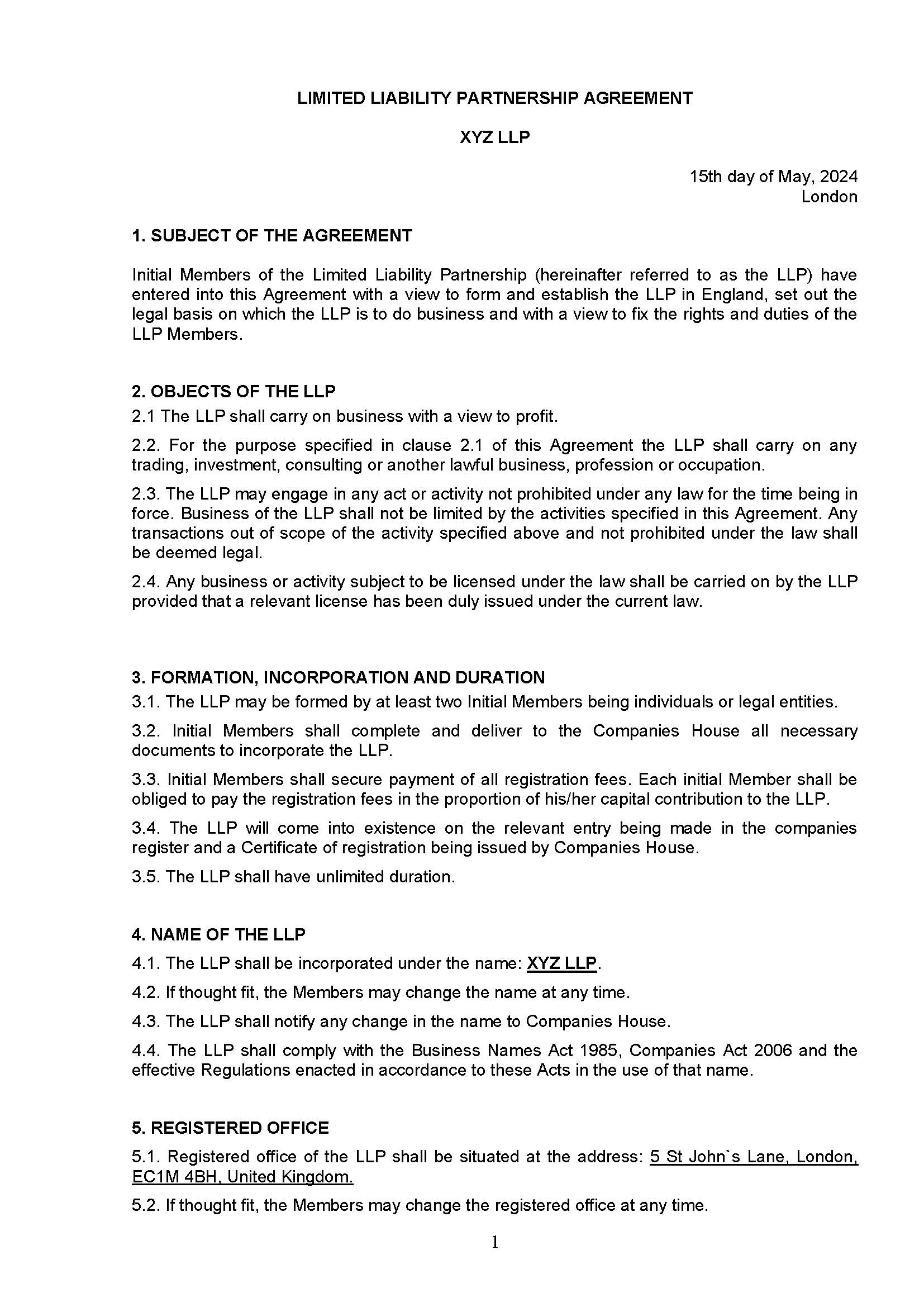
Confirm that the founders have come together to establish a partnership and have determined its future structure: name, registered office, amount of capital contributions to be made by each partner, and who will act as designated members.
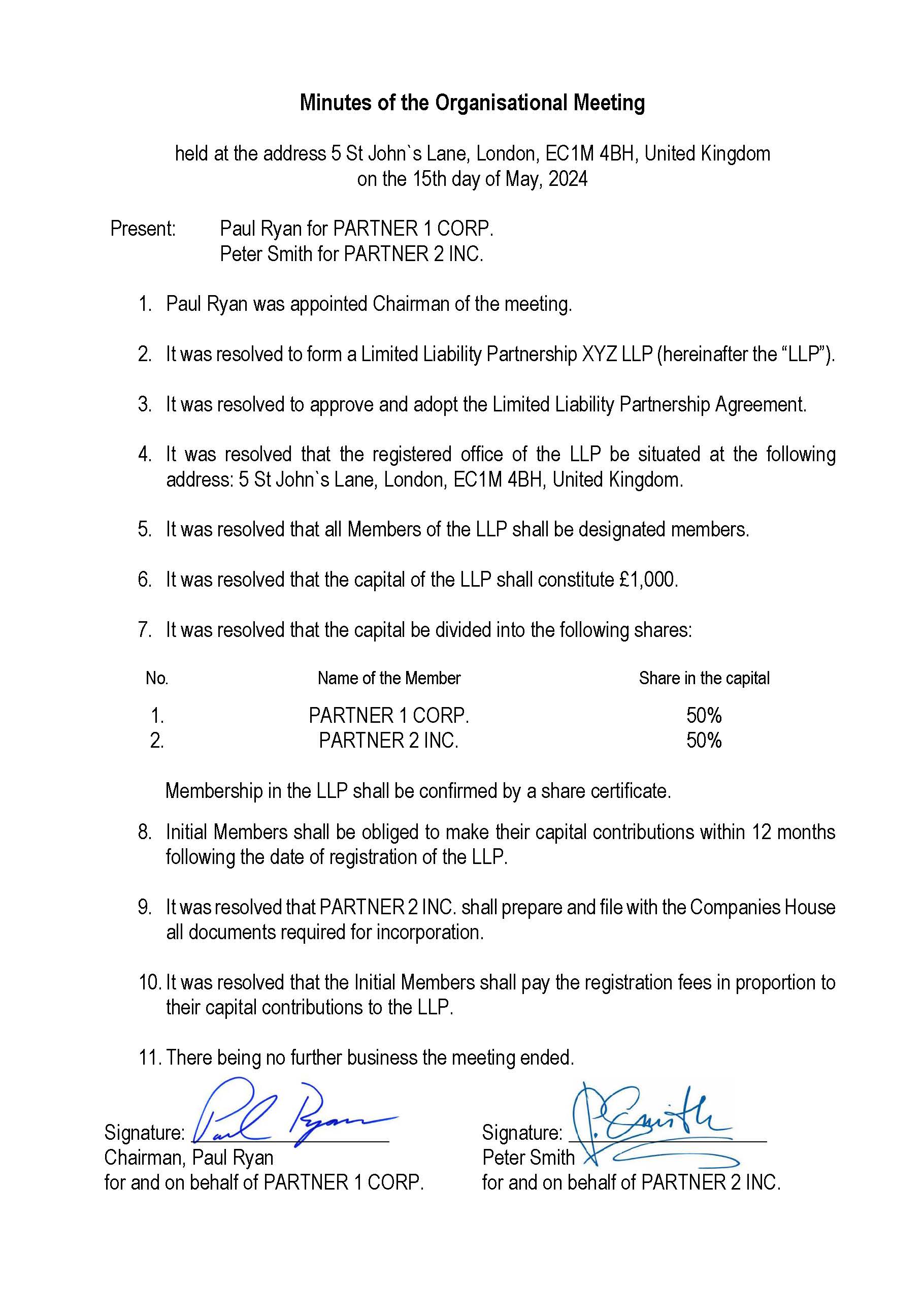
Record the registration of the partnership, its registered office, appointment of a managing partner, and issue of membership interest certificates.
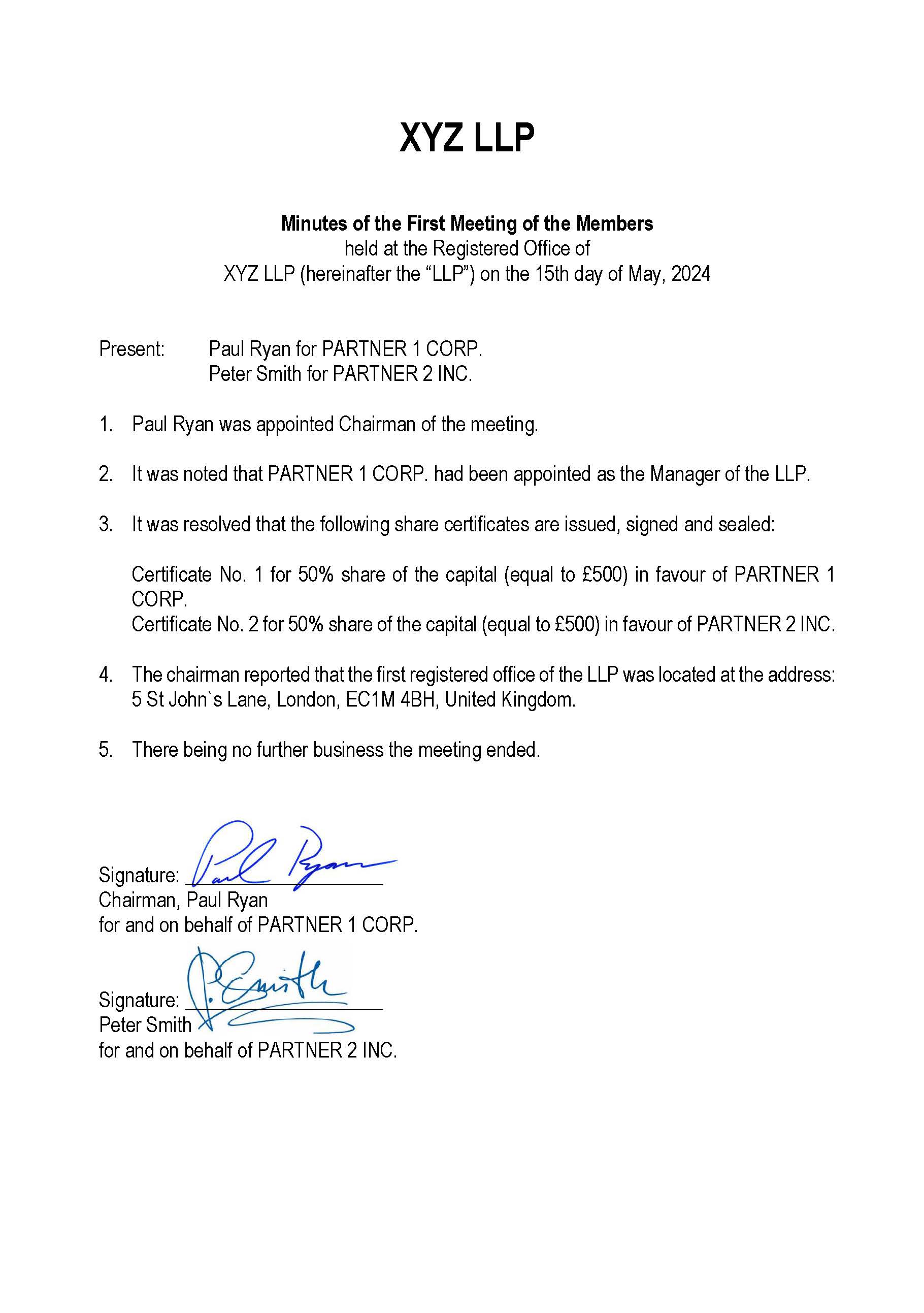
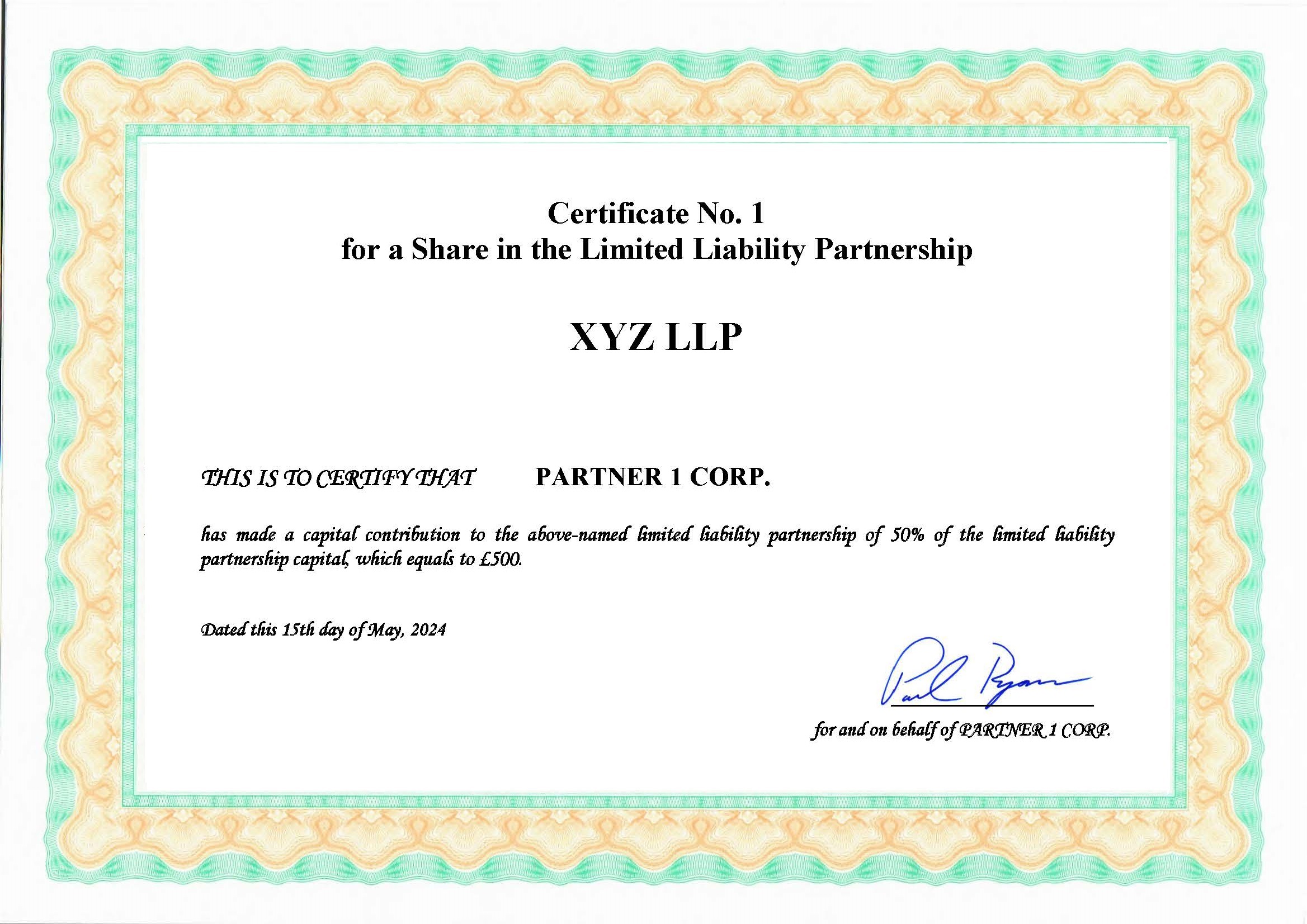
Confirms a member’s share in the capital of the LLP.
The UK offers a favourable tax environment for the international asset structuring: no corporation tax on most incoming dividends, exemption from capital gains tax on the sale of subsidiaries (subject to holding at least 10% of shares for 12 months – the Substantial Shareholding Exemption), and no withholding tax on dividends paid to shareholders. Additional advantages include strong legal protection and the high standing of English law, possibility of 100% foreign ownership, and an extensive network of double taxation treaties (over 140) which help to reduce the tax burden when repatriating profits.
The UK is a popular destination for IT and fintech companies (payment services, e-wallets, crowdfunding, investment platforms) because it offers access to:
Agencies, business consultants, design studios, marketing specialists, recruiters, and many other professionals operating in the international market with clients from the US, the EU, and the UK opt for a UK-based company. The jurisdiction enjoys a high level of trust among Western corporations, which, among other benefits, simplifies the processing of payments.
The limited liability partnership structure is particularly relevant when multiple partners work together and wish to allocate profits flexibly. Consequently, this legal form is most commonly chosen for the provision of professional services, such as:
Thanks to the partnership’s tax transparency, it can be used effectively in ordinary trading business, provided that the partners are UK non-residents, the actual management and trading take place outside the country, and the partnership’s income is not derived from UK sources.
Activity: Forex broker services
Regulator: Financial Conduct Authority (FCA).
Operational obligations: compliance with capital and liquidity requirements, submission of regular reports, segregation of client funds from the firm’s own funds, compliance with AML/CFT requirements, processing and storing personal data in accordance with the GDPR, compliance with sanctions regimes, and maintaining a robust IT infrastructure.
Consequences of non-compliance: fines, suspension or revocation of registration, and possible criminal liability.
Key challenges of opening a UK account:
UK banks are renowned for their high reliability, strict regulation and global trust, and are convenient for international payments and transactions in major currencies. However, they operate under very strict compliance requirements, which often makes it virtually impossible for non-residents and businesses in ‘high-risk’ sectors to open an account. Furthermore, fees and operational restrictions are often higher and more stringent than those in neobanks.
Neobanks are often more flexible when it comes to client onboarding, making the account opening experience quicker and easier. However, compared to traditional banks, they offer a limited range of products, and you may find that your counterparties may be somewhat wary of dealing with them.
The client planned to launch real estate operations in the UK, involving the rental of a local office and the hiring of staff.
GSL specialists handled the company incorporation process and arranged for the opening of an account with one of the UK’s major payment service providers. While real estate operations as such do not require a licence, the business must register as a ‘supervised business’ for AML (Anti-Money Laundering) regulatory purposes. We therefore prepared the necessary documentation for registration with the supervisory authority – HMRC (HM Revenue and Customs), submitted information, and oversaw the process until confirmation was received that the company had been entered into the Supervised Business Register.
The client got a corporate structure fully ready for operations, complete with an active business account and confirmation of compliance with AML supervision requirements.
A major, long-standing client was looking to set up in London a representative office for a Dutch company within its group.
GSL handled the entire registration process for the representative office (structured as a ‘UK establishment of an overseas company’): we compiled the necessary documentation (including the parent company’s articles of association and financial statements) and completed and filed the required forms. Additionally, at the client’s request, we prepared the parent company’s internal corporate documentation regarding the establishment of the rep.office.
Registering this separate unit enabled the client to represent its interests and develop its business in a new jurisdiction, establishing the required level of legal and physical presence. In subsequent years, we provided ongoing support for the office’s operations and, when the client no longer required it, arranged for its closing.
The client is a freelance machine learning engineer working in data science and artificial intelligence. He already owned a Seychelles company, but new customers were unwilling to work with an offshore entity.
It was decided to register a UK LLP with the Seychelles company and the client himself as partners. Since a contract with a customer was due to be signed shortly, the registration had to be completed within a tight time frame. We were already well-acquainted with the client and his business, allowing for a swift KYC process and prompt submission of incorporation documents.
Establishing a legal entity in a more reputable jurisdiction enabled the client to retain a customer who had refused to work with an offshore company, while also offering the future possibility of segmenting order flows by region. Furthermore, thanks to the tax transparency of an LLP, the client incurred no UK tax liability, as the income was intended to be accumulated by the Seychelles company (one of the partners). An additional benefit was the ability to open an account with a UK neobank that onboards local legal entities but does not work with offshore companies.
The client needed to restore their UK company to the register.
Since the company had been subject to compulsory strike-off and less than six years had elapsed since that event, the company was eligible for ‘administrative restoration’ via Companies House, avoiding the need for court proceedings. Outstanding financial, tax, and corporate filings were prepared, late-filing penalties were paid, and an application for restoration was submitted using the prescribed form.
The company was administratively restored to the register and returned to active status, with all outstanding filing obligations settled. This enabled the client to continue using the company for business purposes; furthermore, although the public register reflects the fact that the company was struck off and subsequently restored, its legal existence is deemed to have never been interrupted.
By default, a branch will carry the name of its overseas parent company. However, a different name may be chosen provided it meets the established requirements: authorisation must be obtained to use ‘sensitive’ words in the name, or words implying a connection to the UK government or other public bodies.
A branch will always have a separate registration number, starting with the prefix ‘BR’ (Branch).
A branch must have a physical address (not a P.O. Box) in the UK. This serves as the official address for correspondence from public authorities. The address must always be within the same country where the branch was originally registered (for example, a branch registered in Scotland must use a Scottish address).
Although a branch is not a separate legal entity, the procedure for registering one is similar to that for registering a company. Within one month of establishing a physical presence for business purposes in the UK, the following documents must be prepared and submitted to Companies House:
The form must include: details of the parent company and its officers; details of the branch, including its authorised representatives; and the details of persons authorised to receive official correspondence in the UK.
All documents drawn up in a language other than English must be accompanied by a certified English translation.
A UK establishment does not need to prepare its own separate set of financials. Instead, it must file the annual statutory accounts of its overseas parent company with Companies House.
At present, redomiciliation – defined as changing a legal entity’s country of incorporation while preserving all existing legal relationships – is not available in the United Kingdom. Existing corporate legislation provides no mechanism for transferring an existing company either into or out of the country.
By far the easiest and fastest way to close down a private company that has ceased operations is to have it struck off the Register. This process can be either voluntary or compulsory.
Voluntary Striking Off
Before applying to strike the company off the Register, it is necessary to settle matters regarding its assets: distribute them among shareholders, close bank accounts, transfer domain name rights, etc.. This needs to be done because, once the company is struck off the Register (effectively dissolved), all undistributed assets, including money in bank accounts, will pass to the Crown (become state property).
An application for strike off may be submitted only if the company:
Procedure
In practice, Companies House sends a notice regarding the company’s strike-off approximately 6 months after the director’s application. Therefore, in terms of time frame, the procedure takes an average of 6 months once all documents are submitted.
Compulsory Striking Off
Companies House may compulsorily strike a company off the register if it believes the company is no longer carrying on business or is failing to meet its legal obligations: failing to file or filing late its accounts and confirmation statements, failing to pay fees or penalties, operating without a director, etc.
A company dissolved in this manner may be restored to the register within 6 years of it being struck off.
There are 3 ways a company can be liquidated:
Members’ Voluntary Liquidation
The company’s assets are used to settle its debts, and the remaining funds are distributed among the shareholders. Once the application for liquidation is filed, the company’s bank accounts are frozen and will only be accessible with court authorisation. Any money not distributed to members by completion of the liquidation passes to the Crown.
Procedure
The declaration must specify the time frame for the company to pay its debts (no more than 12 months from the start of the liquidation) and be signed by the majority of directors before a solicitor or notary public. The declaration must include a statement of the company’s assets and liabilities.
Liquidation takes approximately 1 year once all necessary documents are submitted.
A liquidated company can be reinstated only by court order.
This option is only available if a company was struck off by the Registrar under Sections 1000 and 1001 of the Companies Act 2006 (as inactive), i.e., compulsorily rather than voluntarily, within the last 6 years, and was carrying on business prior to being struck off.
Procedure
Moreover, the applicant must be a director or shareholder who were a director or shareholder at the time of the company’s dissolution.
If the company held assets (such as bank accounts) that vested in the Crown, written consent must be obtained from the Bona Vacantia Division.
This option has to be used when the quicker and cheaper administrative restoration route is unavailable. It is typically used by:
As with administrative restoration, the standard time limit for restoration by court order is 6 years from the date of the company’s dissolution. An exception applies to restoration for the purpose of claiming damages for personal injury, in which case there is no time limit.
Procedure
Upon restoration, the UK company is deemed to continue its existence as if it had never been struck off the register, meaning its legal existence was uninterrupted, although the public register will show information regarding the strike-off/dissolution and subsequent restoration.
UK Ltd companies and LLPs are required to submit their annual accounts (financial statements) and tax returns to UK government authorities – Companies House and HM Revenue and Customs (HMRC).
The requirement to prepare and submit accounts is mandatory, regardless of whether the company or partnership has conducted business. If no business activity took place (no bank transactions, contracts, or invoices), an entity needs to prepare and file dormant accounts.
An audit is not mandatory for dormant or small companies. A company qualifies as small if, during the accounting period, it does not exceed at least two of the following three criteria:
| For accounting periods beginning between 30 September 2013 and 5 April 2025 | For accounting periods beginning on or after 6 April 2025 | |
| Annual turnover | GBP 10,2 million | GBP 15 million |
| Balance sheet total | GBP 5,1 million | GBP 7,5 million |
| Average number of employees | 50 | 50 |
A company’s first accounting period begins on the date of its incorporation and typically ends on the last day of the month in which the incorporation anniversary falls. This results in the first accounting period being slightly longer than 12 months (though not exceeding 18 months). Subsequent accounting periods cover a standard 12-month term and begin immediately after the preceding period ends.
The deadline for filing accounts with Companies House is no later than 21 months from the date of incorporation for the first accounting period, and no later than 9 months from the end of the accounting period – for subsequent ones.
| LTD | LLP |
| All limited companies are required to file a Corporation Tax Return (Form CT600). The tax period typically spans 12 months, and the return must be submitted within 12 months of the period’s end. The company must pay the tax due 9 months and 1 day after the end of the tax period. | All limited liability partnerships are required to file a Partnership Tax Return (Form SA800). The tax period typically spans 12 months. There are two filing deadlines depending on the submission method: paper returns must be filed by 31 October, while online returns must be filed by 31 January following the end of the tax year.
For partnership members, the deadline for filing a personal tax return electronically and paying any tax due is also 31 January. |
Contents of accounts:
| LTD | LLP |
| UK companies with subsidiaries are required to prepare consolidated accounts for the group. Exemptions include to parent companies that qualify as small (see criteria above) or are themselves subsidiaries of other companies. | A UK LLP is required to prepare and file consolidated (group) accounts with Companies House if it is a parent undertaking and the group as a whole exceeds the thresholds for small enterprises. Exemptions include parent LLPs that qualify as small (see criteria above) or are subsidiaries of another, larger company that prepares and publishes consolidated financial statements. |
Subsidiaries are companies in which a parent company holds more than 50%. In certain cases, a company may be deemed a subsidiary even if the ownership interest is 50% or less, provided it is controlled by the parent company. A company controls a subsidiary if the following conditions are met:
Failure to submit acceptable accounts on time is a criminal offence. Company’s directors or LLP’s designated members are personally liable for the timely filing of accounts and may themselves be fined for missing deadlines. In addition, late filing penalties are imposed on the legal entity itself. For private companies and LLPs, the penalties are as follows:
| Length of delay | Penalty amount |
| up to 1 month | GBP 150 |
| from 1 to 3 months | GBP 375 |
| from 3 to 6 months | GBP 750 |
| more than 6 months | GBP 1500 |
If accounts are filed late in 2 successive financial years, the late filing penalty will be doubled.
Furthermore, in the absence of accounts it is impossible to deliver a tax return.
| LTD | LLP | ||||||||||||||||||||
The late filing of a tax return (CT600) is subject to a fixed penalty:
If a tax return is late 3 times in a row, the GBP 200 penalties are increased to GBP 1,000 each. |
The late filing of a tax return (SA800) is subject to tax charged to each member of the LLP:
The late payment of tax is subject to a penalty of 5% of the outstanding amount:
There is also interest charged interest on the amount owed. |
The UK tax system comprises corporate tax, VAT, and a progressive income tax, yet it imposes no withholding tax on dividends, offers a broad exemption regime for dividends and capital gains for holding companies, and maintains an extensive network of double taxation treaties. The UK combines tax rates that are moderate by global standards with a sophisticated system of incentives – covering investments, R&D, innovation, and holding structures – and is regarded as one of the most well-developed and convenient onshore jurisdictions for transparent international business and structuring.
The advantages of establishing a company in the UK include: 1) a high level of trust in the jurisdiction among counterparties and banks; 2) fast, fully remote registration; 3) the option for 100% foreign ownership and management; 4) simplified reporting for small businesses; 5) incentive schemes for investments, R&D, innovation, and holding structures; 6) an extensive network of double taxation treaties (DTTs); and 7) a high level of digitalisation in government services.
Yes, a non-resident can set up a company in the UK. Moreover, both shareholders and directors can be non-residents. The only mandatory requirement is a UK registered office address.
As a general rule, a proposed name must not be identical to the name of another registered company. Exceptions apply where:
A name is considered identical (‘same as’) to the name of an existing company if the only difference to an existing name is:
Examples:
Hands UK Ltd = Hand’s Ltd = Hands Ltd.
Řeal Coffee Café Ltd = Real Coffee Cafe Ltd.
Plum Technology Ltd = Plum Technology & Company Ltd
A company name may be considered ‘too similar’ if it differs from another name by only a few characters, symbols, or punctuation marks, or if it looks and sounds the same.
Example: «Easy Electrics For You Ltd» — same as «EZ Electrix 4U Ltd».
Yes, you can. However, an official exemption from using the word ‘Limited’ in the company name is usually granted to companies limited by guarantee. Standard commercial companies with share capital (companies limited by shares) will find it extremely difficult to obtain such an exemption. This is because the option is primarily available to non-profit or socially significant organisations. Such an organisation must clearly state its non-profit objectives (e.g., the advancement of science, art, education, or charity) in its articles of association and must strictly prohibit the payment of dividends, the return of capital, or the distribution of any income among its members.