Preparation of Financial Summaries
(for non-active entities)
Price
350 USD

Accounting & Bookkeeping
Mandatory. Accounting records must be provided to the registered agent semi-annually and retained for at least 7 years.
Financial Statements Preparation
Mandatory Financial Summary for all corporate entities, excluding qualifying small holding structures.
Accounting Standards
No mandatory local framework. IFRS or US GAAP are fully permitted.
Consolidated Financial Statements
Not required under Seychelles corporate legislation.
Dormant Reporting Option
Available, if no transactions occurred, in the form of a nil Financial Summary.
Filing Financial Statements with the Registry
Not required. The Financial Summary is submitted exclusively to the registered agent and not disclosed.
Filing Financial Statements with the Tax Authority
Not required, provided no income is derived within the Seychelles.
Statutory Audit
Not required for IBCs.
Corporate Tax Return
Not required, if there is no revenue within the jurisdiction.
Annual Return
The Financial Summary must be filed annually with the registered agent.
The accounting records must be retained for 7 years from the close of the relevant financial period.
The Financial Summary includes core corporate data (summarizing the balance sheet and profit and loss performance) based on underlying accounting ledgers.
All Seychelles entities, except for qualifying small holdings, are legally required to compile the Financial Summary annually.
The finalized Financial Summary must be submitted to the registered agent within 6 months of the company’s financial year-end.
This filing is kept confidential, is not kept in the public domain, and can be accessible only to government regulators upon formal inquiry.
If a company needs full-scope financial reporting for external parties, the year-end financial closing includes:
There are no mandatory local accounting frameworks imposed on IBCs, the reporting platform is selected based on corporate objectives.
Statutory audit is not legally required for standard IBCs in the Seychelles. Financial statements are audited on a voluntary basis to comply with foreign controlled foreign company (CFC) regulations, institutional banking demands, or investor mandates. In these circumstances, full IFRS financial statements are delivered to a licensed CPA to obtain a formal auditor’s report.
The compiled (audited) financial statements are used to:
Parallel to accounting records maintenance and the submission of the Financial Summary, a Seychelles entity must fulfill ongoing corporate governance obligations:
Every company must maintain accounting records sufficient to:
Accounting records include the full suite of documentation capturing corporate transactions.
This includes records of all revenues and expenditures, asset and liability registers, purchase and sale logs for goods and services, bank statements, transaction history reports from electronic payment systems (EMIs), commercial contracts, invoices, receipts, and acts of completion.
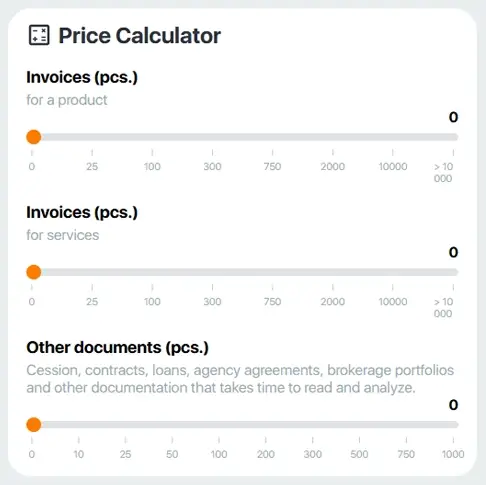
Accounting Fee Calculator
The interactive calculator provides an estimated cost for accounting, bookkeeping, and statutory audit services.
Total fees depend on annual gross turnover, transaction volume, invoice frequency, the format of primary documentation submissions, and the overall scope of required advisory services.
Statutory audits are performed by licensed Certified Accountants.
International Business Companies must submit financial information to their registered agent annually using the prescribed statutory framework – a Financial Summary.
The Financial Summary is not a public document; it is not disclosed to third parties and is kept exclusively by the registered agent. It is provided to the regulator (FSA) only upon an official government request.
The exact scope of reporting obligations depends on the category of the entity and the nature of its operations. Under Section 175 of the International Business Companies Act 2016, entities are specifically categorized into large, non-large, and holding companies.
| Type of Seychelles IBC | Financial Summary Obligation |
| Large Entity (Annual gross turnover > 50 million SCR) | Mandatory |
| Non-Large Entity (Non-holding structure) | Mandatory |
| Holding Company (Non-large holding structure) | Exempt |
Only small holding companies that do not engage in business activities and solely hold shares in other entities are exempt from filing.
The Financial Summary must be submitted to the registered agent within 6 months from the end of the financial year.
It aggregates core performance indicators, operating as a simplified balance sheet and an abbreviated profit and loss statement.
The Financial Summary does not replace full financial statements.
Failure to compile the Financial Summary or transfer primary documentation to the registered agent triggers administrative penalties ranging from 2 000 USD to 10 000 USD and striking off from the corporate registry.
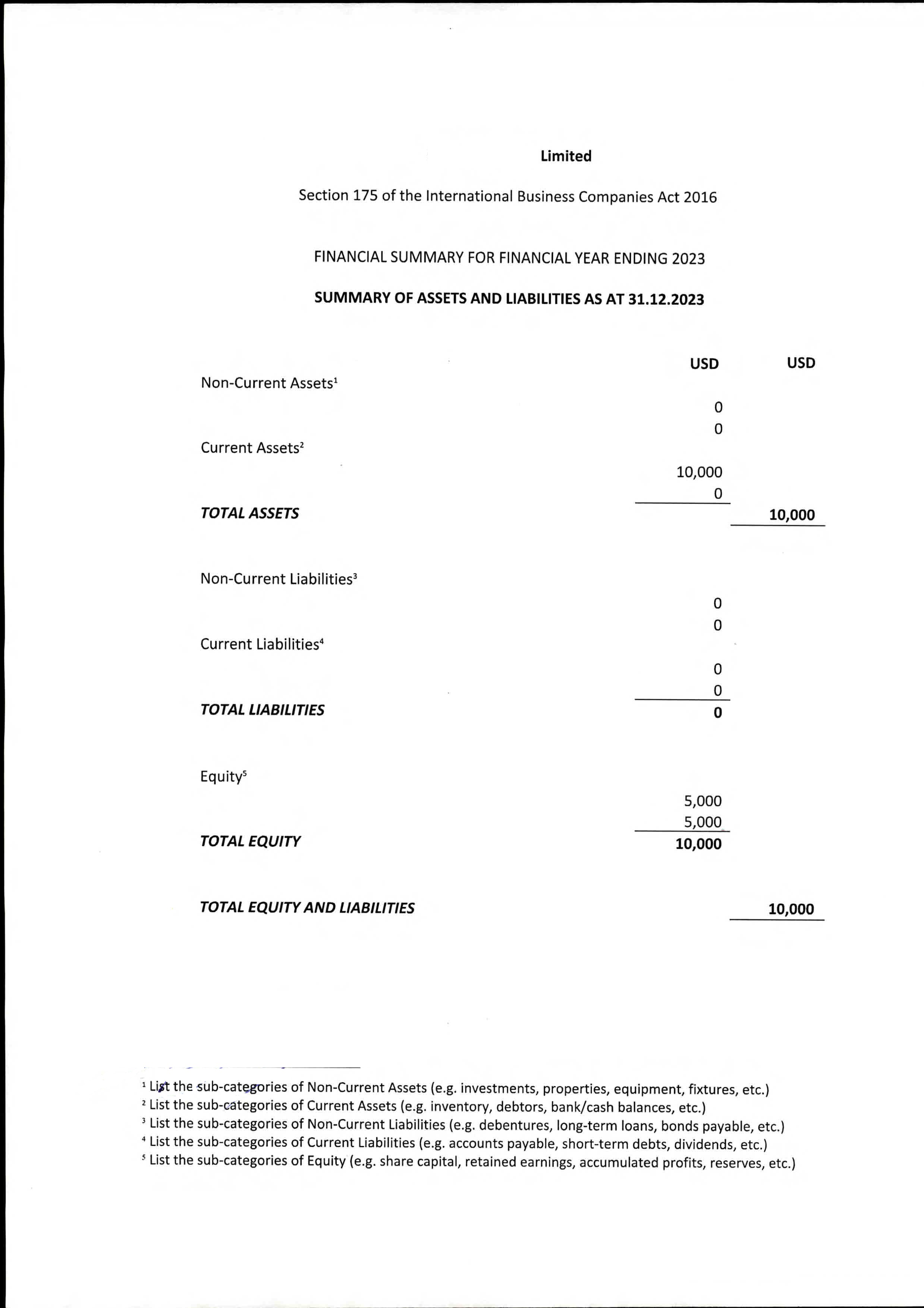
A complete set of financial statements provides an enhanced disclosure framework and is distinct from the statutory Financial Summary. Full statements are prepared on a voluntary basis depending on specific commercial objectives:
Standard set of full Financial Statements includes:
Seychelles corporate legislation does not enforce a specific domestic accounting framework for standard IBCs. In global practice, International Financial Reporting Standards (IFRS) are systematically implemented, as this framework is universally recognized by international banks, statutory auditors, and tax authorities.
The financial year of a Seychelles IBC is designated by the directors upon incorporation and typically spans either a standard calendar year or a 12-month from the date of registration.
The preparation of consolidated financial statements is not required under Seychelles corporate law. If a Seychelles IBC operates as the parent entity of a corporate group, the necessity of compiling consolidated financial records is determined by the guidelines of the chosen global accounting framework (e.g., IFRS) or the specific compliance demands enforced in the jurisdictions where the subsidiaries operate.
Under the International Business Companies Act 2016, statutory audit is not required and is optional for standard IBCs.
Audit requirements apply to specific categories of regulated entities operating under the supervision of the Seychelles FSA. These include:
Even in the absence of a mandatory domestic requirement, a voluntary audit may be executed to satisfy the following corporate objectives:
For standard IBCs undergoing a voluntary independent audit, there are no rigid domestic legislative restrictions regarding the jurisdiction of the auditor. The review is conducted by independent audit firms possessing recognized global qualifications, particularly when financial statements are compiled under IFRS.
However, if the entity is formally regulated and holds a license issued by the FSA, the audit must be executed exclusively by a local licensed Seychelles auditor approved by the FSA.
The audit initiates with an evaluation of the company’s business model, corporate structure, operational activities, source of funds, banking channels, and accounting architecture to identify key risk profiles and determine the scope of substantive testing.
The auditor then performs a detailed examination of accounting ledgers and primary source documentation to verify the accuracy of recorded revenues, operational expenses, related-party transactions, and cash flows, alongside the validation of balance sheet assets and liabilities. The auditor retains the right to issue management queries or request additional supporting documents.
Upon completion of the fieldwork, the auditor issues an independent auditor’s report containing a professional opinion on the fair presentation of the financial statements.
If a Seychelles entity establishes full local economic substance and maintains physical administrative operations within the jurisdiction (such as renting a local commercial office and onboarding local personnel to manage an international group) specific domestic tax obligations apply.
The distribution of salaries to local employees triggers mandatory corporate withholding requirements, bound to the timely deduction and remittance of personal income tax and national social security contributions to the local authorities.
No. The Financial Summary must adhere to basic accounting guidelines, accurately summarizing the balance sheet and profit and loss metrics of the company.
The document must be compiled exclusively in English or French, which are the official languages of the Seychelles.
Although the International Business Companies Act 2016 does not impose a rigid domestic accounting framework (such as standard IFRS) on standard IBCs, the registered agent retains the statutory right to reject the summary and demand a revised filing under global accounting frameworks if the submitted data fails to clarify the true financial position of the company.
Yes. The obligation to file an annual Financial Summary applies to inactive (dormant) corporate structures. If the entity recorded zero bank movements and commercial transactions during the reporting period, you are legally bound to prepare and transfer a nil Financial Summary to the registered agent, unless the structure qualifies as a small holding company exempt from simplified reporting.
Disregarding this rule due to a lack of commercial activity constitutes a material compliance breach and triggers standard administrative fines.
No. Seychelles corporate laws fully permit the retention of accounting ledgers and primary source documentation in either original hard-copy paper format or digital (electronic) formats. The central regulatory requirement enforced by the FSA is that electronic records must be complete, precise, and instantly accessible for system export. Submitting high-resolution scanned duplicates of commercial invoices and bank transaction logs to the registered agent semi-annually ensures full regulatory compliance.
The FSA enforces corporate compliance through systematic, unannounced on-site inspections of the registered agents themselves. Regulatory inspectors review physical and digital archives at the agent’s premises, randomly auditing individual company files.
If the inspectors discover missing semi-annual accounting logs or unfiled annual Financial Summaries for an audited entity, the FSA levies material statutory fines on both the registered agent and the non-compliant company, alongside imposing immediate operational locks on the entity.
Under the Companies Ordinance framework, the primary legal and fiduciary liability for structuring accounting records, transferring files to the registered agent, and ensuring reporting accuracy rests with the directors. Statutory fines and regulatory penalties for non-compliance are issued personally against the directors.
Nominee directors, if utilized within the corporate structure, will not absorb criminal prosecution or financial liability risks; they will immediately freeze all corporate operations if the ultimate beneficial owner fails to provide bank statements and commercial invoices on time.
If an IBC conducts operations exclusively outside the geographical boundaries of the Seychelles and generates solely foreign-source income, it is exempt from corporate tax registration with the Seychelles Revenue Commission (SRC) and does not require a local Tax Identification Number (TIN).