Preparation of the Annual Financial Return
For a dormant company
Price
550 USD

Bookkeeping
Mandatory; records and underlying documentation must be retained for at least five years.
Preparation of Financial Reporting
Required in the form of an Annual Financial Return.
Accounting Standards
No specific accounting standards are prescribed; IFRS may be used.
Consolidated Financial Statements
Not required under BVI legislation.
Nil Return Filing
Permitted. A nil Annual Financial Return may be filed where applicable.
Filing Financial Reporting with the Registry
Not required. The Annual Financial Return is filed only with the Registered Agent and is not publicly disclosed.
Filing Financial Statements with the Tax Authorities
Not required.
Statutory Audit
Not required for companies.
Dormant Status
There is no formal dormant company status. However, a company may have no business activities and may file a nil return where applicable.
Tax Return
Not required.
Annual Return
An Annual Financial Return is filed with the Registered Agent each year.
Throughout the financial year, the company must maintain accounting records, including records of income and expenditure, movements in bank accounts, contracts, loans, investments and other transactions.
Records and underlying documentation must be retained for at least five years. Failure to retain the required documentation may result in penalties and, where necessary, make it impossible to prepare the relevant financial reporting.
All BVI companies are required to prepare and submit a Annual Financial Return to their Registered Agent each year.
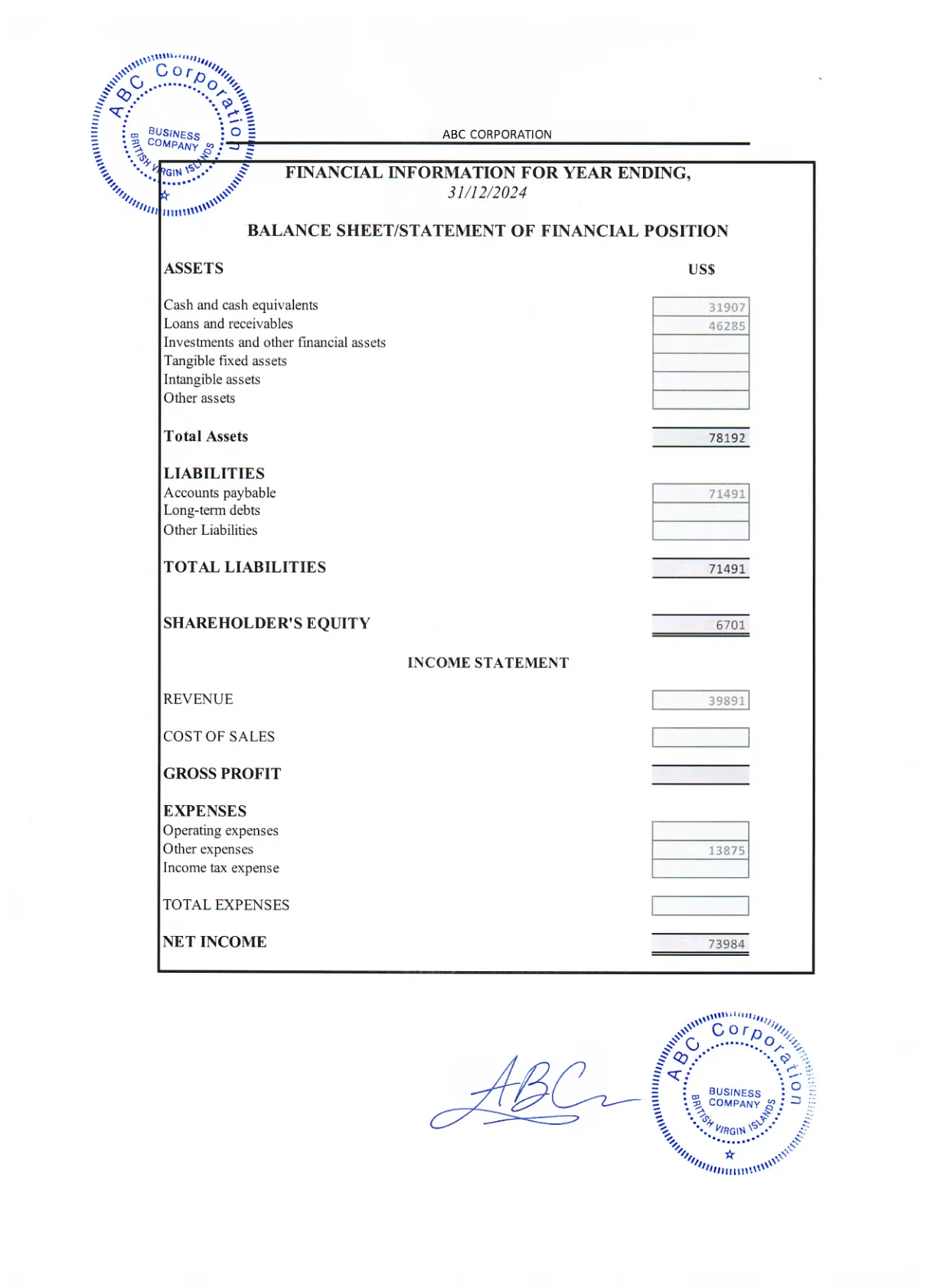
The Annual Financial Return contains key financial information, including a balance sheet and a simplified profit and loss statement, and is prepared based on the company’s accounting records.
Depending on statutory requirements, investor demands, and internal needs, a company may prepare different types of financial reports at the end of the financial year (or on an ongoing basis):
An audit may be required for CFC purposes or at the request of a bank or investors.
In such cases, the financial statements are generally prepared in accordance with IFRS and provided to an independent auditor for the issuance of an audit report.
In addition to maintaining accounting records and filing the Annual Financial Return, BVI companies must:
* If the Annual Financial Return filing deadline is within two months, the fees for its preparation may be increased by a factor of 1.5–2.
A company must maintain records and underlying documentation in a form that is sufficient to:
The term records and underlying documentation covers documents reflecting the company’s financial and business activities. In particular, it includes accounts and records relating to all sums of money received and expended by the company, sales and purchases of goods, and the company’s assets and liabilities, as well as invoices, contracts and similar documents.
The company’s records and underlying documentation must be retained for at least five years from the date of completion of the relevant transaction or from the date on which the company terminates the business relationship to which the records and underlying documentation relate.
Records and underlying documentation may be kept at the office of the company’s registered agent or at another place or places, within or outside the BVI, as determined by the directors. Where they are kept elsewhere, the company must provide its registered agent with a written record of the physical address of the place or places where the records are kept and, where applicable, notify the registered agent of any change in location. The registered agent is also required to maintain a record of the places outside the BVI where the company’s records and underlying documentation are kept and the name of the person who maintains and controls them.
The records may be maintained in written or electronic form, subject to the requirements of the Electronic Transactions Act.
The company must also:
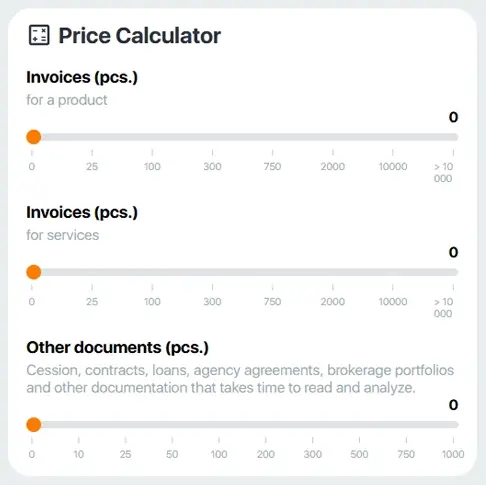
The calculator provides an estimate of the cost of accounting, compliance and audit services for your company.
The cost depends on the company’s turnover, the number of invoices and transactions, the format in which supporting documentation is provided, and the scope of services required.
IFRS audits can be arranged in Cyprus, the UAE or Hong Kong.
Since 1 January 2023, BVI business companies have been required to file an Annual Financial Return with their registered agent annually in the prescribed form.
The Annual Financial Return is not a public document and is not filed with the Registrar. It is retained by the registered agent and may be made available to the regulator upon request.
The initial penalty for late filing of the Annual Financial Return is USD 300 for the first month. If the company fails to remedy the breach, the penalty increases by USD 200 for each subsequent month, up to a maximum of USD 5,000.
In addition, the company may lose its Good Standing status, which may prevent it from obtaining certificates of good standing and may affect its ability to conduct certain corporate and banking transactions. Prolonged non-compliance may ultimately result in the company being struck off the Register.
The Annual Financial Return must be provided to the registered agent within nine months after the end of the company’s financial year. It contains key financial information in a prescribed simplified format and is not equivalent to a complete set of financial statements.
Although BVI companies are generally not required to file full financial statements with the BVI tax authorities or undergo a statutory audit, in practice they may need to prepare full financial statements for a number of purposes, including:
In practice, companies may prepare different types of financial reporting depending on their particular requirements:
BVI legislation does not prescribe a mandatory accounting framework for the preparation of full financial statements by ordinary BVI business companies. In practice, IFRS may be used where appropriate for the company’s purposes or required by a bank, investor or other business partner.
A company’s financial year is determined by its directors and specified in the company’s internal records.
A complete set of financial statements may include:
BVI legislation does not generally require ordinary BVI business companies to prepare consolidated financial statements solely by virtue of having subsidiaries. However, consolidated financial statements may be required depending on the group’s structure, the applicable accounting framework and the requirements of banks, investors or other third parties.
Where prepared, consolidated financial statements generally present the assets, liabilities, income, expenses and cash flows of the parent company and its subsidiaries as those of a single economic entity.
The BVI Business Companies Act does not impose a general requirement on BVI business companies to have their financial statements audited.
An audit may be required for certain categories of entities, including licensed entities, such as companies operating in the financial services sector, investment funds and other regulated entities. Such entities may be required to prepare audited financial statements annually and submit them to the relevant regulator.
Even where no statutory audit is required, an audit may be necessary for:
BVI legislation does not generally prescribe a specific jurisdiction in which an auditor of an ordinary BVI business company must be based. In practice, audits are conducted by independent audit firms with the relevant qualifications and professional credentials, including international or otherwise recognised audit firms, particularly where the financial statements are prepared in accordance with IFRS.
An audit begins with an assessment of the company’s business activities, corporate structure, transactions, sources of income, bank accounts and accounting systems to identify key risks and determine the scope of the audit.
The auditor then performs a detailed examination of the company’s accounting records and underlying documentation, including the accuracy of the recognition of income and expenses, related-party transactions and cash flows, as well as the existence and valuation of assets and liabilities. Where necessary, the auditor requests additional documents and explanations.
Upon completion of the audit, the auditor issues an independent auditor’s report containing an opinion on the financial statements.
Where a company has economic substance in the BVI and carries on business activities there, for example, by maintaining an office, employing personnel or being directed and managed from the BVI, additional tax and compliance obligations may apply.
In particular, where a company has employees, it may be subject to payroll-related taxes and social security contributions.
BVI companies are required to assess annually whether they fall within the scope of the economic substance requirements. Where a company carries on a relevant activity, it may be required to satisfy the applicable economic substance requirements and make the relevant filings.
All BVI Companies Are Required To:
Where the company does not carry on a relevant activity, file the applicable Form One; where it is tax resident in another jurisdiction, file Form Two. A pure equity holding entity files the simplified Form Four;
The filing is generally due within six months after the end of the financial year and includes information on the nature of the company’s activities, its office and employees, expenditure in the BVI, management and control of the company, and compliance with the applicable economic substance requirements.
Failure to comply with the economic substance filing requirements may result in financial penalties and, in certain circumstances, the company being struck off the Register.
No. An audit is not generally required for standard BVI business companies. Statutory audit requirements may apply to licensed entities, investment funds and other regulated structures. In other cases, an audit may be carried out where required or appropriate, for example, by a bank or for CFC reporting purposes in the beneficiary’s country of tax residence.
All BVI business companies are required to maintain accounting records that accurately reflect their financial position and, since 1 January 2023, to file an Annual Financial Return with their registered agent within nine months after the end of the financial year.
The Annual Financial Return contains prescribed financial information in a simplified format and is not equivalent to a complete set of financial statements. Full financial statements are prepared where required or appropriate for specific purposes, such as bank compliance, investment, CFC reporting or the sale of a business.
BVI legislation does not generally prescribe a mandatory accounting framework for full financial statements of ordinary BVI business companies. In practice, companies may prepare management accounts or financial statements in accordance with IFRS, depending on the purpose of the financial reporting and the requirements of banks, investors or tax authorities in other jurisdictions.
No. BVI companies are not generally required to file full financial statements with the BVI authorities, and such financial statements are not publicly available. However, companies are required to provide an Annual Financial Return to their registered agent each year in the prescribed form set out in the Schedule to the BVI Business Companies (Financial Return) Order, 2023. The Annual Financial Return contains a simplified statement of profit or loss and statement of financial position.
No. The Annual Financial Return is a prescribed simplified financial return containing key financial information about the company. It is provided to the registered agent within nine months after the end of the financial year and is not publicly disclosed.
The Annual Financial Return is distinct from full financial statements prepared in accordance with IFRS or another accounting framework.
No. The obligation to maintain accounting records continues to apply to all companies. Even if a company has no transactions, it must have evidence of the absence of business activity and file the relevant Annual Financial Return.
Failure to comply with the requirements for retaining records and underlying documentation may result in a penalty of up to USD 50,000.
Failure to provide records and underlying documentation to the registered agent without delay in response to a request made in connection with a request from the BVI Financial Services Commission or another competent authority may result in a penalty of up to USD 75,000.
Full financial statements together with an audit may be required for purposes such as complying with CFC requirements in the beneficiary’s country of tax residence, meeting a bank’s compliance requirements, raising investment or selling the business.
In such cases, the company may prepare full financial statements, often in accordance with IFRS or another applicable accounting framework, and have them audited by an independent auditor.